The Early Years of Christ
To understand the beauty of the Lucan narrative, we must first look at the man behind the pen. Luke occupies a unique space in the New Testament, offering a perspective that bridges the gap between the faith’s Jewish roots and its universal reach.
The Physician’s Purpose: Why Write?
“Many have undertaken to draw up an account of the things that have been fulfilled[a] among us, 2 just as they were handed down to us by those who from the first were eyewitnesses and servants of the word. 3 With this in mind, since I myself have carefully investigated everything from the beginning, I too decided to write an orderly account for you, most excellent Theophilus, 4 so that you may know the certainty of the things you have been taught.” (Luke: 1:1-4, NIV)
Who is Luke?
As a reminder, this meticulous detail comes from Luke’s unique background. Luke was a physician and a close traveling companion of the Apostle Paul. Historically recognized as a Gentile, he is likely the only non-Jewish author of a Gospel. His writing reflects the mind of a meticulous historian and the heart of a healer, blending scholarly precision with deep compassion.
What Sets Luke Apart?
While Matthew, Mark, and Luke form the Synoptic Gospels (due to their shared sequence and wording), Luke possesses distinct characteristics that differentiate him from the others:
- The Historian’s Detail: Luke begins his Gospel by stating his intent to write an “orderly account.” He anchors the life of Christ in secular history, citing Roman rulers and specific census markers.
- The Universal Savior: While Matthew emphasizes Jesus as the Jewish Messiah, Luke presents Him as the Savior of all mankind. He traces Jesus’ genealogy all the way back to Adam, rather than stopping at Abraham, signaling that Christ’s redemption is for the entire human race.
- Focus on the Marginalized: Luke’s “thread of life” consistently highlights those often overlooked: women (such as Elizabeth, Mary, and the sisters of Bethany), the poor, and the outcasts (like the Samaritans).
- The Role of the Holy Spirit: Luke emphasizes the presence and power of the Holy Spirit more than any other Synoptic writer, a theme he carries directly into his second volume, the Book of Acts.
Connecting the Threads: Old to New
In Chapter 2, Luke masterfully connects the Old Testament promises to their New Testament fulfillment. The birth of Christ is not a disconnected event; it is the climax of a long-standing covenant.
| Old Testament Thread | New Testament Fulfillment (Luke 2) |
| Prophecy of Micah: The Messiah must be born in Bethlehem. | The Census: God uses a Roman decree to move Joseph and Mary to Bethlehem. |
| The Priesthood: Holiness required for the firstborn. | The Presentation: Jesus is brought to the Temple according to the Law of Moses. |
| The Consolation of Israel: Isaiah’s promise of comfort. | Simeon & Anna: The aged prophets recognize the Child as the “Light to the Gentiles.” |
The Christ-Centered Flow
As we move into Chapter 2, notice the rhythm of the narrative. It transitions from the humble, gritty reality of a manger to the cosmic declaration of angels. This “thread of life” demonstrates that Christ did not just enter history; He transformed it. He is the bridge between the Law and Grace, the fulfillment of the Prophets, and the hope of the world.
Through Luke’s eyes, we see a Christ who is both the Son of God and the Son of Man, intimately involved in the human experience while remaining the sovereign King of the ages.
The Census & The Legal Line
Before the birth of Jesus, a decree was issued that a census would be taken. Joseph and Mary traveled from Nazareth to Bethlehem, the City of David. Because Joseph was of David’s line, he provided the legal right to the throne. By Joseph’s naming and claiming Jesus, the Davidic “kingly” line was legally passed to Him—effectively keeping the promise God had made to David and Abraham. In this way, the covenant was fulfilled.
The Reality of the Cave: Context and Culture.
The narrative transitions from the cosmic (the census and lineage) to the intimate and gritty reality of a birth.
Luke 2:6-12 (NIV) 6 While they were there, the time came for the baby to be born, 7 and she gave birth to her firstborn, a son. She wrapped him in cloths and placed him in a manger, because there was no guest room available for them. 8 And there were shepherds living out in the fields nearby, keeping watch over their flocks at night. 9 An angel of the Lord appeared to them, and the glory of the Lord shone around them, and they were terrified. 10 But the angel said to them, “Do not be afraid. I bring you good news that will cause great joy for all the people. 11 Today in the town of David a Savior has been born to you; he is the Messiah, the Lord. 12 This will be a sign to you: You will find a baby wrapped in cloths and lying in a manger.
Observation: A Mirror of Things to Come
In verse 7, I see a profound foreshadowing of Christ’s death. Luke records that Mary wrapped Him in “cloths”—specifically, long strips of cloth used to keep an infant’s limbs straight. These strips bear a striking resemblance to the burial cloths used to wrap a body for the tomb.
Furthermore, while the Bible mentions a manger (a feeding trough), historical tradition often places this manger inside a cave where animals were kept. If this tradition holds true, a beautiful and somber “thread of life” emerges: Jesus began His life in a cave wrapped in cloths, and He would eventually end His earthly life in a cave, wrapped in cloths.
Cultural & Historical Context To understand the gritty reality of this setting, the NIV Cultural Backgrounds Study Bible provides these insights:
- Cloths (2:7): Parents and midwives wrapped an infant’s limbs in long strips of cloth to help them grow straight. These were used until the limbs became firm, often for up to two months.
- The Manger: A feeding trough for domestic animals. Because people often kept animals in caves connected to or near their houses, the tradition of a “cave birth” began circulating in Bethlehem as early as the second century. While Luke does not explicitly name a cave, the archaeological setting makes it a strong historical possibility.
The Announcement: Then vs. Now In society today, when a newborn enters the world, fanfare and joy are usually kept within the family and those important to the child’s life. But here, a Heavenly Host of Angels appeared to make the announcement to the world. While most people were preoccupied with their own issues, the lowly shepherds were filled with joy.
Luke 2:13-20 (NIV) 13 Suddenly a great company of the heavenly host appeared with the angel, praising God and saying, 14 “Glory to God in the highest heaven, and on earth peace to those on whom his favor rests.” 15 When the angels had left them and gone into heaven, the shepherds said to one another, “Let’s go to Bethlehem and see this thing that has happened, which the Lord has told us about.” 16 So they hurried off and found Mary and Joseph, and the baby, who was lying in the manger. 17 When they had seen him, they spread the word concerning what had been told them about this child, 18 and all who heard it were amazed at what the shepherds said to them. 19 But Mary treasured up all these things and pondered them in her heart. 20 The shepherds returned, glorifying and praising God for all the things they had heard and seen, which were just as they had been told.
The Lowly Witness
Despite the biblical traditions of figures like Moses and David, most people of status throughout the Roman Empire viewed shepherds as lowly, unclean, or even dangerous. Yet, in God’s sovereign design, these were the first to hear the greatest news in history. The fact that they were tending flocks at night suggests a warmer, more temperate season—aligning with the “mirror” of the Fall feasts rather than the cold, rainy winters of December (a date selected centuries later to coincide with Roman festivals).
But there is a deeper truth here: Who was chosen to see Jesus in the manger? As we have discovered, and as it is written in John 3:16-17, This universal reach, which John would later famously record, is already being demonstrated here in Luke’s fields. Christ did not come for the elite. He came from the unseen to reach the broken, the downcast, and the misunderstood. By appearing first to shepherds, He signaled from His very first breath that the “Way” was open to the marginalized.
A Mother’s Memory
Verse 19 offers a beautiful, intimate moment. Mary—perhaps possessing a mother’s instinct or a divine knowing of her Son’s destiny as the Savior of the world—cherished every detail. She did not just observe these events; she “pondered them in her heart.”
This stands in stark contrast to our world today. While the shepherds spread the word externally, Mary began internal work. We live in an age where everything is recorded digitally and shared instantly, often leaving us with nothing truly kept for reflection. Mary’s example calls us back to a “New Way “where we stop to ponder and remember these divine moments in our hearts, allowing the “Internal Ark” of our faith to be built on real, lived memory rather than a digital archive.
In the Temple: The Law and the Promise
Following the Law of Moses, Joseph and Mary traveled to Jerusalem to present the infant Jesus to the Lord. As it is written in Exodus 13:2, “Consecrate to me every firstborn male… whether human or animal.” This act was more than a custom; it was the formal recognition that the Savior was under the Law so that He might eventually redeem those bound by it.
In the temple courts, they met Simeon, a man whose life was defined by a singular, Holy Spirit-led hope: he would not taste death until he had looked upon the Messiah. Moved by that same Spirit, Simeon took the child in his arms and offered the Nunc Dimittis—his song of dismissal.
The Revelation to the Nations
Simeon’s prophecy (Luke 2:29-32) expands the scope of Christ’s mission. He saw in that tiny child a “Light for revelation to the Gentiles” and the “Glory of Israel.” This marks the exact moment where the “Mirror” of the Old Testament begins to reflect outward to the whole world. Simeon, a faithful and righteous man, asked to be dismissed in peace to the “Way of Death,” for he knew that the “Way of Life” had finally arrived for all nations.
The Sword and the Heart
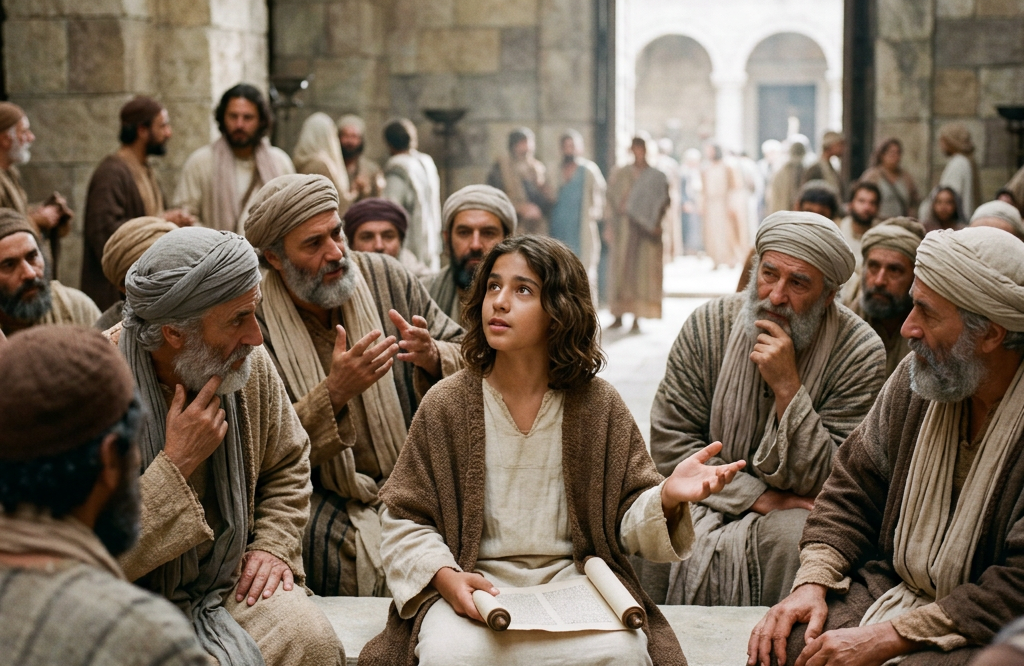
However, Simeon’s blessing came with a sobering warning to Mary. He prophesied that this child would be a “sign spoken against” and that a sword would pierce her own soul.
This brings us back to the “Internal Ark” we discussed. Simeon reveals that Christ’s presence would force the “thoughts of many hearts to be revealed.” He isn’t just a political Savior; He is a spiritual refiner. The “sword” that would eventually pierce Mary at the foot of the Cross is the same refining fire that invites us today to look inward, reflect, and ensure our hearts are prepared for His Kingdom. The submission to the Father’s plan, begun in His infancy, reaches a silent but pivotal milestone twelve years later.
The Boy at the Temple
41 Every year Jesus’ parents went to Jerusalem for the Festival of the Passover. 42 When he was twelve years old, they went up to the festival, according to the custom. 43 After the festival was over, while his parents were returning home, the boy Jesus stayed behind in Jerusalem, but they were unaware of it. 44 Thinking he was in their company, they traveled on for a day. Then they began looking for him among their relatives and friends. 45 When they did not find him, they went back to Jerusalem to look for him. 46 After three days they found him in the temple courts, sitting among the teachers, listening to them and asking them questions. 47 Everyone who heard him was amazed at his understanding and his answers. 48 When his parents saw him, they were astonished. His mother said to him, “Son, why have you treated us like this? Your father and I have been anxiously searching for you.”
49 “Why were you searching for me?” he asked. “Didn’t you know I had to be in my father’s house?”[f] 50 But they did not understand what he was saying to them.
The Authority of Twelve
The number twelve is often associated with concepts of governance and organization. By appearing at the Temple at age twelve, Jesus was asserting His role as the head of the new “Twelve Tribes”—a spiritual Israel.
| Biblical Usage | Significance |
| 12 Sons of Jacob | Foundation of the Physical Nation (Israel) |
| 12 Sons of Ishmael | Foundation of a Great Nation |
| 12 Gates of the New Jerusalem | Eternal access to God’s Presence |
| 12 Apostles | Foundation of the Spiritual Church |
At twelve, Jesus was at the bridge between childhood and manhood. In the Jewish tradition, this is the age of becoming a “Son of the Commandment” (Bar Mitzvah). Jesus was showing the teachers that He wasn’t just following the commandment, He was the Commandment.
By standing in the temple at twelve, Jesus was signaling that the foundation of a New Covenant was being laid. He was moving from the “custom of the parents” to the “business of the Father.”
The Prophetic Significance of Three
When Mary and Joseph lost Jesus for three days, it wasn’t just a parental oversight; it was a prophetic shadow. In the biblical “mirror,” the three-day period is almost always a threshold of transition—the time spent between the old reality and the new revelation.
- Jonah’s Three Days: Jonah spent three days in the darkness of the fish before being “resurrected” to his mission at Nineveh.
- The Temple’s Three Days: Jesus Himself later prophesied, “Destroy this temple, and in three days I will raise it up” (John 2:19).
- The Three-Day Search: For Mary and Joseph, these three days were a season of “anxious searching” and darkness. Finding Him in the Temple was a “resurrection” of their understanding—they saw Him no longer as just their son, but as the Son of the Father.
- The Transition: Here, the three-day “loss” of Jesus serves as a small-scale mirror of the three days He would later spend in the tomb—a period of anxious searching followed by the revelation of His true authority.
The Authoritative Voice
You noted that the leaders were “amazed” yet felt no “malice.” This is a crucial observation for your research on the “Way.”
Malice usually grows from fear of lost power. At this stage, the Pharisees and teachers saw a brilliant boy, not a threat to their system. Jesus used this “Strategic Pause”—these quiet years of development—to speak with an authority that bypassed their religious defenses. He spoke the Truth so purely that they couldn’t help but listen.
This serves as a lesson for us today: The Truth spoken in love and humility often finds a home where the “sword” of debate cannot enter.
Just as Simeon saw the Light in the infant, the teachers in the temple saw the Wisdom in the boy—yet the world still waited for the ‘Fullness of Time’ to truly understand who stood before them.
“My Father’s House”
When Mary speaks of her anxiety, Jesus responds with a question that defines the rest of His life: “Didn’t you know I had to be in my Father’s house?” Even His parents—the ones who saw the angels and heard the shepherds—did not fully understand. It reminds us that even those closest to the “Mirror” can sometimes miss the reflection. It calls us to be even more vigilant in our own hearts, ensuring that we recognize His authority when He speaks in our lives today.
Note for the Readers
As we look at these numbers, don’t see them as mere math. See them as a signature. If God was this precise with the age of a boy in a temple and the days, he was “lost,” how much more precise is He with the timing of your life?
If you are currently in your own “three-day search,” a time of confusion or spiritual darkness—remember that the third day always brings you to the Father’s House.
Summary Closing Prayer
Heavenly Father, we thank You for the meticulous heart of Luke and the “thread of life” he wove through these pages. We ask that the truth of the Savior—born in a cave, laid in a manger, and found in the Temple—would move from our heads to our hearts. Just as Mary pondered these things, teach us to build our own ‘Internal Ark’ of faith. If we are in a season of searching, lead us back to Your house, reminding us that Your timing is perfect and Your promises are secure. We pray this In Jesus Christ our Lord and Savior Amen.
Tomas
© 2026 The-Way.blog Digital Publications. All Rights Reserved.
Footnotes & Citations
- Luke 1:1-4; 2:1-52 (NIV): Primary scriptural text for the “orderly account” and the life of the adolescent Christ.
- Exodus 13:2: The Mosaic Law requirement regarding the consecration of the firstborn, cited during the Presentation in the Temple.
- John 3:16-17: Applied context for the universal reach of the Gospel message first announced to the shepherds.
- NIV Cultural Backgrounds Study Bible: Reference for the historical use of swaddling cloths (limbs straightening) and the archaeological context of Judean cave-dwellings/mangers.
- Micah 5:2: The Old Testament prophetic foundation for the Messiah’s birth in Bethlehem (The City of David).
Resources & References
Archeological Studies of Bethlehem: Insights into first-century domestic architecture, where animals were sheltered in lower-level “caves” or grottos beneath or adjacent to the main living quarters (kataluma).
Historical Context of the Roman Census: References to the Census of Quirinius (Luke 2:2) and its alignment with secular Roman history and tax decrees.
The “Cave Tradition”: Documentation of the second-century writings of Justin Martyr and the Protoevangelium of James regarding the Nativity site.
Gematria and Biblical Numerology: Scholarly exploration of the number 12 (divine governance) and 3 (completeness/resurrection) within the Pentateuch and the Gospels.
The Nunc Dimittis: Analysis of Simeon’s song (Luke 2:29–32) as a bridge between the “Consolation of Israel” and the “Light to the Gentiles.”
 The-Way
Leave a comment