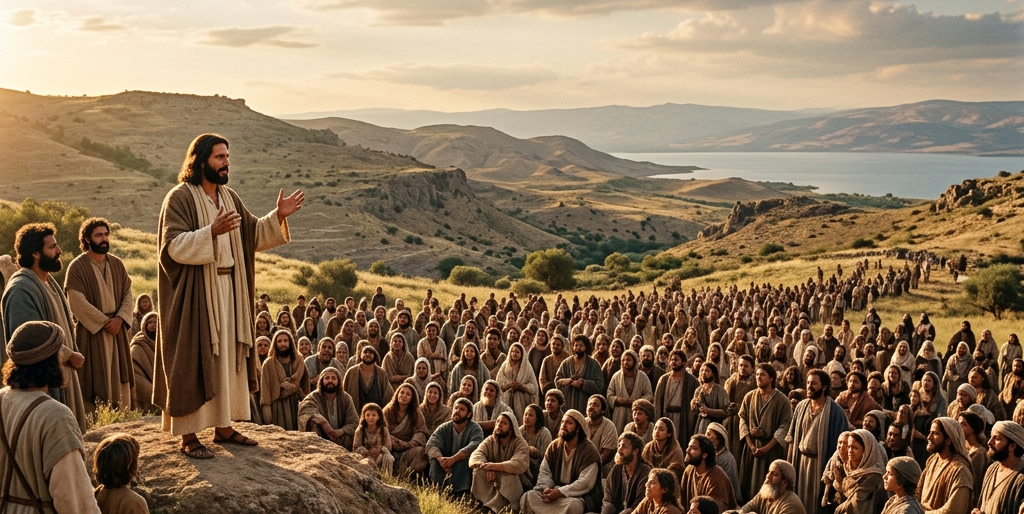
Receiving the Word (Part 1)
Introduction
At the very beginning of Chapter 8, Luke introduces us to the women who traveled alongside Jesus and the Apostles. These women beautifully symbolize the exact spiritual truths Jesus is about to teach. They didn’t just hear the Word physically; they received it deeply into their spirits. They willingly gave up materialistic wealth and social security for the hope of a life with Christ, letting their light shine, and most of all, they followed Him in the way—becoming part of His true, immediate family.
The Thread That Binds Us Together
When you look at these three sections as a single narrative arc, a powerful theme emerges:
- The Sower: Receives the Word Deeply (Internal)
- The Lamp: Displays the Word Clearly (External)
- Jesus’ Family: Embodies the Word Relationally (Communal)
True discipleship is a progression. It begins with a vulnerable, well-cultivated heart that allows the seed of truth to sink deep. It naturally moves outward, shining a light that cannot be hidden by worldly distractions. Ultimately, it reshapes our identity entirely, placing us in the immediate, intimate family of God—just as those faithful women modeled for us from the very start. To understand how to cultivate such deep faith, we must look at the first teaching Jesus gives on the road in verses 4 through 15.
1. The Sower: Receives the Word Deeply (Internal)
“While a large crowd was gathering and people were coming to Jesus from town after town, he told this parable: ‘A farmer went out to sow his seed. As he was scattering the seed, some fell along the path; it was trampled on, and the birds ate it up. Some fell on rocky ground, and when it came up, the plants withered because they had no moisture. Other seed fell among thorns, which grew up with it and choked the plants. Still other seeds fell on good soil. It came up and yielded a crop, a hundred times more than was sown.’”
A parable is a short, simple story used to illustrate a moral, spiritual, or universal truth. By drawing a parallel between familiar everyday situations and abstract, complex ideas, it provides listeners with a clear, memorable lesson about how they should behave or what they should believe.
Through this specific story, Jesus shows that just because He is God’s chosen agent does not mean people respond to Him automatically. Using standard Middle Eastern farming practices, Jesus specifies four different types of soil on which the seed falls, calling on His audience to truly “hear” what is being said. To understand this call, we have to look closely at the condition of each heart Jesus describes:
- The Path (The Hardened Heart): The word is dropped on a trampled, compressed path. Because it cannot penetrate, the enemy easily snatches it away. This represents a heart hardened by cynicism, pride, or deep-seated resistance to change.
- The Rock (The Shallow Heart): The seed sprouts quickly but lacks depth. When moisture runs out—or as Jesus explains, when testing and temptation arrive—it withers. This is the emotional, superficial reception that loves the benefits of faith but panics at the costs.
- The Thorns (The Crowded Heart): The soil is rich enough for growth, but it is already occupied. The worries, riches, and pleasures of this life grow alongside the word, eventually choking its oxygen. The plant survives, but it never matures or bears fruit.
- The Good Soil (The Noble and Good Heart): This heart hears the word, retains it, and through perseverance, produces a massive harvest.
Spiritual Takeaway: Growth requires active cultivation. We often ask God to change our circumstances, but this parable asks us to examine our soil. Are we too busy (thorns), too guarded (path), or too superficial (rock) to let truth take root?
Luke 8:8–15 (The Explanation)
When he said this, he called out, “Whoever has ears to hear, let them hear.” His disciples asked him what this parable meant. He said, “The knowledge of the secrets of the kingdom of God has been given to you, but to others I speak in parables, so that, ‘though seeing, they may not see; though hearing, they may not understand.’
“This is the meaning of the parable: The seed is the word of God. Those along the path are the ones who hear, and then the devil comes and takes away the word from their hearts, so that they may not believe and be saved. Those on the rocky ground are the ones who receive the word with joy when they hear it, but they have no root. They believe for a while, but in the time of testing they fall away. The seed that fell among thorns stands for those who hear, but as they go on their way they are choked by life’s worries, riches and pleasures, and they do not mature. But the seed on good soil stands for those with a noble and good heart, who hear the word, retain it, and by persevering produce a crop.”
Commentary & Analysis
The central theme of Jesus’ parables is the kingdom of God—the dynamic display of God’s promised rule. In the New Testament, this kingdom arrives in phases. Jesus inaugurates it through his earthly ministry and his work on the cross, which establishes the new-covenant promise of forgiveness. This work empowers his disciples to preach the gospel to everyone, a mission ultimately sealed by the arrival of the Holy Spirit.
In this specific parable, the “seed” represents the word of God—the revelatory message of the kingdom. However, because the exact same seed yields four vastly different outcomes, the narrative focus shifts entirely to the quality of the soil.
By using an agricultural analogy, Jesus highlights that responding to God’s word is a long-term process rather than a single, isolated moment. True fruitfulness requires sustained nurturing.
| Soil Type | Condition | Spiritual Outcome |
| 1. The Path | Hardened | Clearly not saved; the word is taken away instantly. |
| 2. Rocky Ground | Shallow | Ambiguous; joy is immediate, but a lack of root leads to falling away under testing. |
| 3. Among Thorns | Crowded | Ambiguous; life’s worries and pleasures choke out maturity; faith is never explicitly mentioned. |
| 4. Good Soil | Noble & Good | Clearly redeemed; they retain the word and perseveringly produce a crop. |
While the ultimate salvation of the first and fourth soils is clear, the text leaves the second and third soils deliberately ambiguous. By design, the literary imagery of the rocks and thorns is meant to challenge the reader, forcing them to question the true health and endurance of temporary or choked faith. In essence, He is awakening us to the fact that if we remain stuck in the middle, we too will end up in the depths of darkness. Instead, we must choose to truly listen to His word and act.
2. The Lamp: Displays the Word Clearly (External)
To understand why a hidden faith cannot remain hidden, we have to look at the short but piercing illustration Jesus gives next in verses 16 through 18:
Luke 8:16–18 (The Parable of the Lamp)
“No one lights a lamp and hides it in a clay jar or puts it under a bed. Instead, they put it on a stand, so that those who come in can see the light. For there is nothing hidden that will not be disclosed, and nothing concealed that will not be known or brought out into the open. Therefore consider carefully how you listen. Whoever has will be given more; whoever does not have, even what they think they have will be taken from them.”
Commentary & Analysis
The transition from the field to the household is intentional. If the Parable of the Sower focuses on how we receive the Word internally, the Parable of the Lamp focuses on how that Word must manifest externally.
1. The Absurdity of Modern Concealment
Jesus uses an everyday household image to point out an absolute absurdity. In the ancient world, lighting a lamp required effort—striking flint, maintaining oil, and trimming a wick. To go through the process of generating light only to immediately suffocate it under a clay jar or a low bed defeats its entire purpose.
Spiritually, Jesus is saying that a genuinely transformed life cannot be privatized. If the seed of the Word has truly found “good soil” in your heart, it will naturally produce a visible crop. Good soil inevitably produces a lamp on a stand. If a person claims to follow Christ but actively hides their faith out of fear, social conformity, or cultural convenience, they are acting against the very nature of the light within them.
2. The Great Disclosure
Verse 17 is often used as a warning about personal secrets being exposed, but in its strict context, it is about the revelatory nature of the Kingdom.
- The Hidden Seed: Works secretly beneath the soil of the heart.
- The Revealed Light: Is brought out into the open for all to see.
The “secrets of the kingdom” given to the disciples are not meant to be kept in an exclusive, elite club. They are being whispered now so they can be shouted from the rooftops later. What is happening quietly in this small traveling ministry in Galilee is destined to illuminate the entire world.
3. The Paradox of Spiritual Momentum
Jesus concludes with a sharp warning that ties right back to the ambiguous soils (the rocks and the thorns): “Therefore consider carefully how you listen.”
He introduces a spiritual law of compounding interest:
- The Upward Spiral (Active Listening): “Whoever has will be given more.” When you actively listen to God’s word and put it into practice, your capacity to receive truth expands. Light breeds light.
- The Downward Spiral (Passive Hearing): “Whoever does not have, even what they think they have will be taken.” If you treat the Word like the hardened path or the thorny soil—hearing it but never acting on it—your spiritual perception will atrophy. Eventually, even the superficial “religion” you thought you possessed will wither away.
Spiritual Takeaway: We do not choose whether our lives display something; we only choose what they display. A heart that genuinely retains the Word becomes a lampstand that guides others into the room. If our faith is invisible to those around us, we must step back and re-examine the soil of our hearts.
3. Jesus’ Family: Embodies the Word Relationally (Communal)
To see how deep reception and external light transform our closest relationships, we look at the climactic encounter in verses 19 through 21:
Luke 8:19–21 (Jesus’ True Family)
“Now Jesus’ mother and brothers came to see him, but they were not able to get near him because of the crowd. Someone told him, ‘Your mother and brothers are standing outside, wanting to see you.’
He replied, ‘My mother and brothers are those who hear God’s word and put it into practice.’”
Commentary & Analysis
This moment can easily be misunderstood as a harsh public snub of Mary and His brothers. However, in the cultural context of first-century Israel, Jesus is doing something far more revolutionary: He is expanding the definition of family identity.
1. The Power of “Standing Outside”
Notice the spatial dynamics Luke sets up in the text. Jesus is inside, surrounded by a dense crowd of disciples, outcasts, and seekers who are hungrily drinking in His teachings. His biological family is stuck “standing outside.”
In the ancient Near East, family was your entire world—it dictated to your legal rights, your social standing, your safety, and your identity. By biological right, Mary and His brothers should have had immediate, front-row access to Jesus. But the crowd creates a physical barrier that mirrors a spiritual reality: Natural ancestry does not guarantee kingdom intimacy.
The Modern Parallel:
Just as physical proximity to Jesus’ family didn’t guarantee a spot inside the house, our modern religious activities don’t automatically guarantee us a place in His kingdom. Going to church regularly, sitting in a pew every Sunday, or giving generously to others, especially when done to be seen or to check a religious box—is simply “standing outside.” You can be culturally close to the things of God while remaining spiritually distant from the heart of Christ. Proximity is not the same as intimacy; attendance is not the same as obedience.
2. The Spiritual DNA of the Kingdom
When Jesus is told His family is outside, He uses the moment to drop a theological anchor: “My mother and brothers are those who hear God’s word and put it into practice.”
Jesus does not demote His biological family; rather, He promotes the faithful listener to the status of immediate kin. He is establishing a new covenant family where bloodlines are replaced by obedience to the Word.
- Natural Lineage: Established by physical birth and DNA.
- Kingdom Lineage: Established by hearing the Word and practicing it.
This brings us completely full circle back to the Introduction of Chapter 8. Who was sitting inside, traveling with Him, and financing His ministry? The women—Mary Magdalene, Joanna, Susanna—and the disciples. They had left their homes and social security to “put the word into practice.” By Jesus’ own definition, these shattered and marginalized women were now His true mothers and sisters.
3. The Hearing-Doing Imperative
This short encounter perfectly connects the three parables by focusing on two key verbs: hearing and doing (putting it into practice).
- If you are the Good Soil, you hear the word and retain it.
- If you are the Lamp on a Stand, your doing becomes visible to all.
- If you are True Family, your hearing and doing bind you to Christ forever.
Spiritual Takeaway: True faith is never meant to be lived out in isolation. Receiving the Word deeply (Internal) and shining our light clearly (External) automatically draws us into a new community (Communal). We are adopted into a cosmic family where our closest bonds are shared with those who walk in obedience alongside us.
Summary / Conclusion
Luke opens Chapter 8 by showcasing a group of faithful women who lived out the very truths Jesus would preach. They took the Word deep into their souls, let their light shine publicly, and left everything behind to join His intimate spiritual family.
The intentional order in which Luke places these accounts reveals a clear roadmap for our own spiritual journeys: it shows us that we must first hear the Word deeply (Internal), so that it can shine out clearly (External), which ultimately binds us together as a new community (Communal). True discipleship is never stagnant. It requires us to constantly inspect our soil, step out from under our jars, and move inside the house—joining the beautiful, global family of those who hear God’s word and put it into practice.
Discussion Questions & Call to Action
Reflection & Discussion Questions
- Evaluating the Soil: Honestly evaluate the current state of your heart. Which of the four soils best describes your current season of life? Are there specific “thorns” (worries, riches, or pleasures) that are currently threatening to choke out your spiritual maturity?
- Lifting the Jar: Jesus states that light is fundamentally meant to be seen. In what areas of your life (e.g., workplace, social circles, family dynamics) are you tempted to hide your lamp under a jar? What is one practical step you can take this week to move your lamp onto a stand?
- Moving Inside: Reflect on “The Modern Parallel” regarding proximity versus intimacy. What are the specific “religious checklists” or routines in your life that might give the illusion of standing close to Jesus while you are remaining “outside” true obedience?
- The Communal DNA: How does redefining your family identity around obedience to God’s Word change the way you view, prioritize, and engage with your local church community?
Call to Action: Cultivating the Word
- The Soil Audit: Set aside 15 minutes this week for intentional silent reflection. Write down the top three things consuming your mental energy and anxiety. Confess them as potential “thorns” and surrender them to God.
- The Visible Step: Identify one person in your immediate circle of influence who needs the light of Christ. commit to performing a tangible act of service or sharing a word of spiritual encouragement with them before the weekends.
- Active Hearing: Before reading Scripture or listening to a sermon this week, consciously pray: “Lord, give me a noble and good heart to retain this word and the perseverance to put it into practice.”
Closing Prayer
Heavenly Father, corporate or individual King of our hearts, we thank You for the living seed of Your Word. We confess that too often we have allowed our hearts to become hardened by the world, shallow in the face of trial, or crowded by the trivial pursuits of this life. Grant us the grace today to cultivate a noble and good soil within our souls. Give us the courage to tear down every clay jar and remove every bed of comfort that we have used to hide Your light. Bring us inside the house, Lord. Strip away our empty religious performance and bind us by Your Holy Spirit to Your true covenant family. May our hearing always lead to doing, so that our lives might yield a massive harvest for Your Kingdom. In Jesus’ powerful name we pray, Amen.
Tomas
The-Way.blog
© 2026 The-Way.blog Digital Publications. All Rights Reserved.
Short Biblical Cross-References
- On Hiddenness and Proclamation (The Lamp):
- Matthew 5:14–16 — “You are the light of the world… let your light shine before others.”
- Mark 4:21–25 — The parallel account of the lamp under a basket, highlighting the measure of listening.
- On Spiritual Perception and Hardened Hearts:
- Isaiah 6:9–10 — The prophetic foundation Jesus quotes regarding “seeing but not perceiving.”
- Hebrews 3:15 — “Today, if you hear his voice, do not harden your hearts.”
- On Hearing and Doing (True Family):
- James 1:22–25 The warning against being merely hearers of the word who deceive themselves, contrasting them with those who look into the perfect law and do it.
- Matthew 12:46–50 & Mark 3:31–35 — Synoptic parallels detailing the identity of Jesus’ true spiritual family.
- John 15:14 “You are my friend if you do what I command.”
Footnotes, Citations, and Research for Further Study
- The Role of Women in Luke’s Gospel: Luke consistently highlights marginalized individuals. Scholars note that the inclusion of wealthy female patrons like Joanna (the wife of Herod’s manager, Chuza) in Luke 8:1–3 demonstrates both the counter-cultural nature of Jesus’ ministry and the historical reality of how His itinerant mission was financially sustained. See Ben Witherington III, Women in the Ministry of Jesus (Cambridge University Press, 1987).
- First-Century Agricultural Practices: In ancient Middle Eastern farming, it was standard practice to cast seed on the ground before plowing it. This explains why a single field would naturally contain trampled footpaths, shallow rocky patches underneath topsoil, and dormant briar roots that hadn’t yet been turned up. See Joachim Jeremias, The Parables of Jesus (Scribner, 1963).
- The “Secrets of the Kingdom”: The Greek word used for secrets/mysteries here is $\mu v \sigma \tau \eta \rho \iota o \nu$ (mystērion). In the New Testament context, a mystery is not something completely unknowable, but rather a divine truth that was once hidden but is now being actively unveiled through Christ’s ministry. See G.K. Beale, The Use of Daniel in Jewish Apocalyptic Literature and in the Revelation of St. John (Wipf and Stock, 2001).
- Ancient Near Eastern Kinship Dynamics: Family identity in the ancient Mediterranean world was collectivistic rather than individualistic. Redefining family lines based on a shared ideology or obedience rather than strict biological lineage ($\sigma \alpha \rho \xi$, sarx) was a radically disruptive claim that challenged the foundational socioeconomic and religious structures of the Greco-Roman and Jewish worlds. See Bruce J. Malina, The New Testament World: Insights from Cultural Anthropology (John Knox Press, 2001).
Digital Copyright Notice
Copyright © 2026. All Rights Reserved.
This document is protected under international copyright and digital rights management laws.
Fair Use Citation: Short quotations or excerpts used in reviews, essays, or academic papers must provide appropriate attribution referencing the author and title of this work.
Permitted Use: Permission is granted to download, store, electronically view, and print physical copies of this text solely for personal use, private study, small group discussions, or local church ministry settings.
Prohibited Use: No part of this digital publication may be reproduced, redistributed, resold, hosted on public servers, or transmitted in any form or by any means—including photocopying, digital file sharing, recording, or translation into other languages—for commercial purposes without the prior written permission of the copyright holder.

 The-Way
Leave a comment