Mercy and Grace Given
Introduction: Lost in Confusion
Oftentimes, we find ourselves caught between two realities—walking in the light, only to unexpectedly collide with overwhelming grief, confusion, or hopelessness. In the midst of this, we can feel completely overwhelmed by today’s noise and chaos. Expectations set by friends, family, and work can become unbearable. It can feel as though friends have abandoned us, work is causing too many issues, and family at home is only adding to our grief.
It leaves us asking: Does anyone see me?
- The Interruption of Grief: Life can be going perfectly fine until a sudden tragedy or season of confusion completely derails us. The widow woke up one day as a mother, and by evening she was childless.
- Where is God in the Confusion? Oftentimes, we feel lost because we think God is far away from our pain. But Luke 7 shows that Jesus actively intercepts our “funeral processions.” He steps directly into our confusion to bring clarity, life, and grace.
A Widow’s Son
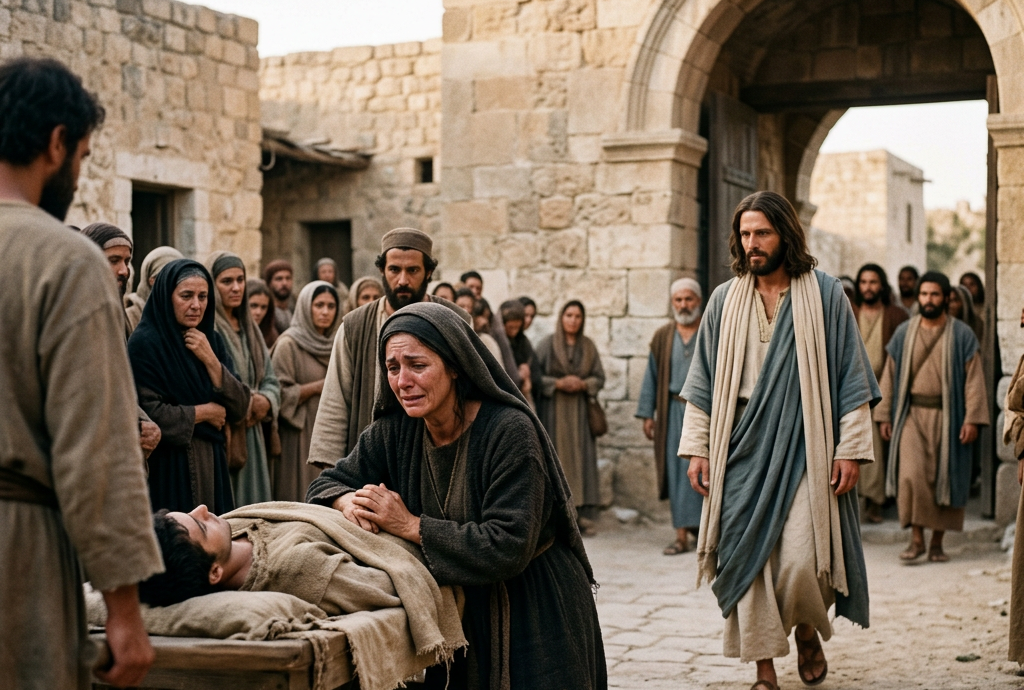
Soon afterward, Jesus went to a town called Nain, and His disciples and a large crowd went along with Him. As He approached the town gate, a dead person was being carried out—the only son of his mother, and she was a widow. And a large crowd from the town was with her. When the Lord saw her, His heart went out to her and He said, “Don’t cry.”
Then He went up and touched the bier they were carrying him on, and the bearers stood still. He said, “Young man, I say to you, get up!” The dead man sat up and began to talk, and Jesus gave him back to his mother.
They were all filled with awe and praised God. “A great prophet has appeared among us,” they said. “God has come to help His people.” This news about Jesus spread throughout Judea and the surrounding country.
— Luke 7:11–17 (NIV)
The Only Son
“Blessed are the poor in spirit, for theirs is the kingdom of heaven.”
— Matthew 5:3 (NIV)
Luke carefully sets the scene, describing where Jesus was going, who was traveling with Him, and the exact moment their paths crossed with the mourning procession at the town gate. The emotional and structural anchor of this passage lies in a single, devastating line: “…the only son of his mother, and she was a widow” (Luke 7:12).
This was an incredibly tragic scene for two distinct reasons:
- The Physical Reality of Death: A dead person was being carried out of the city. Because ancient Jewish law required bodies to be buried outside the community walls to maintain ritual purity, the funeral procession was actively exiting the town gate.
- The Social Reality of Destitution: The woman was already a widow, and she had just lost her only son—her sole remaining source of protection and economic survival. Because women in first-century Greco-Roman and Jewish societies could rarely earn an independent, adequate income, an elderly widow depended entirely on her children for food, shelter, and security [1].
Without her husband and now without her only son, this woman was entirely vulnerable, unprotected, and financially ruined. She was truly “poor in spirit” and completely empty, making her the exact kind of broken person Jesus stepped in to redeem.
Reality Check
This nameless woman surfaces uniquely in Luke’s gospel as one of many biblical references to widows. God’s heart for the vulnerable is woven throughout Scripture:
- Levitical law explicitly warned against taking advantage of widows (Exodus 22:22).
- Moses taught that God actively defends the cause of the fatherless and the widow (Deuteronomy 10:18).
- The early church was specifically structured to care for widows (Acts 6:1).
- James defined pure religion as visiting and looking after orphans and widows in their trouble (James 1:27).
The deep systemic problem here is that the religious and social leaders of the time were failing to follow the heart of the Law. Consequently, this woman would have been disregarded, left behind, and unhelped by the very systems designed to protect her.
Tragically, this same reality rings true daily in modern society—even within our own Christian communities, where the quietest, most vulnerable cries for help can still go unseen and unaddressed.
Divine Authority and Compassion
This miracle—the second major sign in this section of Luke’s gospel (Luke 7:1—8:56)—powerfully highlights Jesus’ deep mercy for the grieving alongside His absolute authority over death.
While the plight of the woman is underscored by her double loss as a childless widow—a recurring focus throughout Luke–Acts (cf. Luke 18:2–5; 20:47; 21:2–3; Acts 6:1; 9:39–41) [2]—the ultimate emphasis in Luke 7:13 is on Jesus’ compassionate initiative. No one asked Him to step in; His heart moved Him to act.
Furthermore, Luke purposefully identifies Jesus as “the Lord” in verse 13. This title is a vital theological climax. It beautifully echoes:
- The angelic announcement at His birth (Luke 2:11).
- Simon Peter’s reverent confession: “Go away from me, Lord; I am a sinful man!” (Luke 5:8).
- The closing challenge of the Sermon on the Plain: “Why do you call me, ‘Lord, Lord,’ and do not do what I say?” (Luke 6:46).
- The Roman centurion’s immediate recognition of Jesus’ absolute spiritual authority (Luke 7:6–8).
When “the Lord” of life meets a procession of death at the city gates, compassion and authority collide to rewrite a hopeless story.
Biblical and Historical Connections
In this moment, we see a powerful display of both Jesus’ humanity and His divine authority. Empathy and sorrow take hold of Him as He looks upon the widow who has lost her only son. This deeply mirrors the Old Testament, where both Elijah (1 Kings 17) and his successor Elisha (2 Kings 4) raised the only sons of desperate widows [3].
By stepping into this scene, Jesus demonstrates profound compassion and mercy to the surrounding crowd. His true humanity shines through as He intimately sees and feels her grief. It invites us to imagine the heart of Creator God, grieved every time one of us is lost to sin.
Ultimately, the people witness Jesus giving the widow her son back. Remarkably, she never even asked for a miracle. Instead, her unspoken heartache touched the heart of Jesus Christ, who—solely through His grace—raised her son from the dead. This act serves as a beautiful foretaste of the promise given to all believers: that we, too, will be raised to live eternally in His heavenly kingdom.
Blind Faith of the Crowd
Although the people were astonished, they only saw Him as a prophet and remained blind to who He truly was. They declared that “God has come to help His people” through a prophet, missing the reality that the Messiah was standing right in front of them. The widow, however, must have known. Yet, she said nothing—quietly keeping it in her heart, just as Mary cherished everything Jesus did in her heart and soul.
| The Crowd’s Perception | The Ultimate Reality |
| They said, “A great prophet has appeared among us.” | He wasn’t just a prophet speaking for God; He was God Himself in their midst. |
| They praised God for “visiting His people” through a messenger. | The Messiah, the King of Kings, was physically standing in the dust with them. |
From the Widow to the Baptist
- The Widow’s Son: Jesus conquers death purely out of grace. Although the people are astonished, they put Jesus in a box by calling Him just a “great prophet,” completely missing the Messiah standing right in front of Him.
- The Perfect Pivot: It wasn’t just the crowds who struggled to fully see who Jesus was. Even John the Baptist—the very one who announced Jesus to the world—found his faith tested when life got dark.
- John the Baptist: From his prison cell, John sends his disciples to ask, “Are you the one who is to come, or should we expect someone else?” (Luke 7:19).
Summary & Conclusion: The Gate of Choice
The town gate of Nain serves as a cosmic crossroads. On that afternoon, two massive processions collided: one marching under the heavy shroud of death, grief, and systemic abandonment, and the other walking in the vibrant light of life, hope, and divine authority.
In our own lives, we regularly find ourselves trapped in the noise and confusion of that first crowd—feeling unseen by friends, overwhelmed by work, and burdened by family trials. We cry out, “Does anyone see me?”
Luke 7 guarantees that the answer is a resounding yes. Jesus does not wait for us to formulate the perfect prayer or find the strength to ask for help. Driven by unsolicited, gut-wrenching compassion, the Lord steps across the cultural and physical barriers of our pain, touches our “coffin,” and speaks life into our dead situations. Yet, this narrative challenges us to look deeper than the crowd did. We must not put Jesus in a box as merely a “great prophet” who provides temporary relief. He is the Sovereign Messiah standing in the dust with us, inviting us to move from blind amazement to deep, anchoring faith—even when the prison cells of our modern lives test our resolve.
Closing Prayer
Heavenly Father,
You are the God who sees, the God who hears, and the God who steps into our deepest places of confusion. Lord, for anyone reading this who feels overwhelmed by the noise of life, abandoned by friends, or crushed by the weight of expectations at work and at home—we ask that You meet them at the gate today.
Forgive us for the times we have put You in a box or doubted Your presence when our circumstances grew dark. Let Your Holy Spirit break through our grief and isolation. Touch the areas of our hearts that have grown cold or dead, and speak Your words of life over us: “Get up.”
Give us the eyes to see You not just as a source of help, but as the Lord of our lives. May we, like Mary and the widow of Nain, quietly anchor our souls in Your sovereign grace, trusting that the same authority that conquered death outside that city gate will carry us into eternity. In the mighty name of Jesus Christ, we pray.
Amen.
Closing Prayer
Heavenly Father,
You are the God who sees, the God who hears, and the God who steps into our deepest places of confusion. Lord, for anyone reading this who feels overwhelmed by the noise of life, abandoned by friends, or crushed by the weight of expectations at work and at home—we ask that You meet them at the gate today.
Forgive us for the times we have put You in a box or doubted Your presence when our circumstances grew dark. Let Your Holy Spirit break through our grief and isolation. Touch the areas of our hearts that have grown cold or dead and speak Your words of life over us: “Get up.”
Give us the eyes to see You not just as a source of help, but as the Lord of our lives. May we, like Mary and the widow of Nain, quietly anchor our souls in Your sovereign grace, trusting that the same authority that conquered death outside that city gate will carry us into eternity. In the mighty name of Jesus Christ, we pray.
Amen.
Tomas The-Way.blog
© 2026 The-Way.blog Digital Publications. All Rights Reserved.
References & Scholarly Citations
If you are publishing this to a platform like The-Way.blog, footnotes or endnotes can be formatted using standard academic commentary guidelines:
- Bock, Darrell L. Luke: 1:1–9:50. Vol. 1. Baker Exegetical Commentary on the New Testament. Grand Rapids, MI: Baker Academic, 1994.
[Provides the core socio-economic context regarding first-century Jewish widowhood, the legalities of burial outside town walls, and the theological weight of Luke identifying Jesus as “the Lord” in verse 13.]
- Green, Joel B. The Gospel of Luke. The New International Commentary on the New Testament. Grand Rapids, MI: Wm. B. Eerdmans Publishing, 1997.
[Details the linguistic connections between Jesus’ compassion ($\text{splagchnizomai}$) and Old Testament prophetic actions performed by Elijah and Elisha.]
- Keener, Craig S. The IVP Bible Background Commentary: New Testament. 2nd ed. Downers Grove, IL: IVP Academic, 2014.
[Supplies cultural data regarding the financial vulnerability of childless widows and Greco-Roman/Jewish family structures.]
- France, R.T. The Gospel of Matthew. The New International Commentary on the New Testament. Grand Rapids, MI: Wm. B. Eerdmans Publishing, 2007.
[Referenced for the contextual analysis of Matthew 5:3 and the concept of being “poor in spirit” as a state of absolute spiritual and physical destitution.]
Resources for Further Study
1. Books & Commentaries
- Exalting Jesus in Luke (Christ-Centered Exposition Commentary) by Thabiti Anyabwile
A highly pastoral yet textually faithful resource, excellent for formatting modern applications, sermon illustrations, and connecting corporate church responsibility to the vulnerable.
- Luke: The Gospel of Amazement (Preaching the Word) by R. Kent Hughes
An exceptional guide for studying the dramatic narrative shifts in Luke’s gospel, specifically emphasizing the direct transition from the Crowd at Nain to John the Baptist’s doubt.
2. Articles & Digital Media
- “The Compassion of Jesus in the Gospel of Luke” (The Gospel Coalition / TGC Journal)
An online theological essay breaking down the specific Greek terms for mercy used throughout Luke-Acts.
- “Widows and Orphans: The Structural Justice of the Early Church” (Center for Christian Civics)
 The-Way
Leave a comment