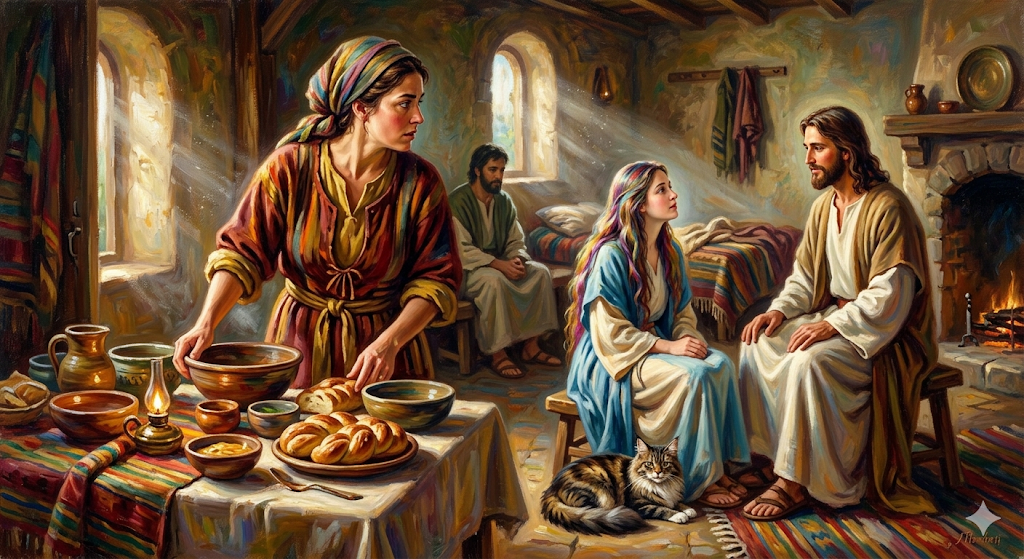
The Power of Twos: The Mirror, The Spirit, and The Sisters
We often find ourselves caught between two worlds: the one we carefully groom for the public eye and the one that breathes quietly behind our ribs. I felt this tension recently in the simple chair of a barbershop. Before me were two women—two distinct ways of being. One was tightly bound, her multicolored hair a loud declaration of uniqueness that, in the movement of her shears, felt like a mask for inner restlessness. The other was fluid, her long hair untied and free, radiating a casual warmth that suggested her outside was simply an extension of a settled inside.
This “Power of Twos” is not just a coincidence of the salon; it is the heartbeat of the New Testament. As we move from the Annunciation to the lives of those who followed, this duality isn’t just an observation of modern aesthetics; it is the ancient heartbeat of the New Testament. We are constantly asked: Where does your faith live?
Is it “tied back” and performative, a serious display of religious uniqueness that results in a “moody” and rigid spirit? Or is it like the free-flowing devotion of the “caring” soul—unburdened, casual in its grace, and deeply rooted in the interior? Whether we look at the busy hands of Martha versus the sitting heart of Mary, or the visible separation of the sheep and the goats, the lesson is the same. The “out” and the “in” are rarely the same, yet our truest testimony is always written in the length we are willing to let our spirits grow.
The power of two was also mentioned in Paul’s writing to the Romans, chapter 7, but the twos in this case represent the flesh vs the soul.
The Pauline Connection
Paul takes “Power of Twos” and turns it inward. “While Mary and Martha appear as two different people in the village of Bethany, Paul argues in Romans that this duality exists within a single heart—that every believer is Mary and Martha at the same time.”
“For the good that I would I do not: but the evil which I would not, that I do.” — Romans 7:19
In Paul’s writing, we see the ultimate “Two”:
- The Law of the Mind (The Soul): The “Mary” inside us that delights in the things of God and wants to sit at His feet.
- The Law of the Members (The Flesh): The “Martha” inside us that is bound, rigid, and constantly pulled toward the “moody” demands of the world.
The Conflict of the “Too Short” Cut
When you felt that your hair was cut “too short,” it was a physical manifestation of a lack of harmony. Paul expresses that same frustrating feeling that the “flesh” has taken too much off, leaving the “soul” exposed and uncomfortable.
“The ‘Power of Twos’ teaches us that we are in a constant state of shearing. Are we being trimmed by the world to look ‘serious,’ or are we being pruned by the Spirit to grow ‘free’? To find the answer, we must first enter the home of two sisters. Let us focus our attention on the ‘out’ and the ‘in’ as seen through Mary and Martha in the Gospel of Luke 10:38-42.”
The House at Bethany: Three Portraits of Relationship
In the village of Bethany, Jesus found a home where the “Power of Twos” was constantly in play. By adding Lazarus to the dynamic, the contrast becomes even sharper: we see the Service (Martha), the Spirit (Mary), and the Sign (Lazarus).
Martha and Mary: The Work vs. The Word
Building on the salon metaphor, we see the sisters as the embodiment of the internal struggle:
- The Bound Performance: Martha’s hospitality is her “uniform.” She is the “serious” one, bound by the expectations of custom and duty. Her relationship with Jesus is transactional—she serves, and she expects others to serve alongside her.
- The Fluid Devotion: Mary is the “free” soul. She is unconcerned with the kitchen or the guests’ expectations. Her relationship with Jesus is transformational; she is there to be changed, not just to perform.
Lazarus: The Silence between the Twos
Lazarus represents a third state: The Testimony. While the sisters speak and act, Lazarus is often defined by his silence and his presence. In the “Power of Twos,” if Martha is the “Out” and Mary is the “In,” Lazarus is the “Life” that proves the power of both.
- The Ultimate Contrast: He is the bridge between the two greatest opposites: Death and Life. His relationship with Jesus isn’t based on what he did or how he sat, but on what Jesus did for him.
The Pruning and the Growth
Let’s think back to the salon, the “too short” cut was a removal of something external. In the story of these three siblings, Jesus performs a different kind of “cut.”
- He prunes Martha’s anxiety, telling her she is “careful and troubled about many things.”
- He protects Mary’s peace, insisting her “better part” will not be taken away.
- He cuts through the bonds of death for Lazarus, demanding he be “loosed and let go.”
Everything in Bethany is about being “unbound”—unbinding the hands from frantic work, unbinding the mind from worry, and unbinding the body from the grave.
The Two Encounters: Different Reactions, Different Affects
When Jesus finally arrives at Bethany, Lazarus has been in the tomb for four days. The way the sisters approach him mirrors the “Serious vs. Free” contrast you observed at the salon:
1. Martha’s Confrontation: The Logic of the “Out” Martha, true to her nature, is the first to run out. Her reaction is active and vocal. She meets Jesus on the road with a statement that sounds like a filtered reproach: “Lord, if thou hadst been here, my brother had not died.”
- The Effect on Jesus: To Martha’s “serious” and theological approach, Jesus responds with The Doctrine. He meets her intellect with intellect, engaging her in a discussion about the resurrection. He challenges her “bound” understanding of the future by bringing it into the present: “I am the resurrection and the life.”
2. Mary’s Prostration: The Language of the “In” Mary stays in the house until she is called. When she finally moves, she doesn’t stand and argue; she falls at His feet—the same place she sat to listen. She says the same words as Martha, but with a very different delivery. She isn’t seeking a theological debate; she is pouring out her soul.
- The Effect on Jesus: This is one of the most profound moments in the New Testament. When Jesus sees Mary weeping, He does not give her a sermon. Instead, “Jesus wept.” Mary’s internal, fluid devotion moves the heart of God to a physical manifestation of grief. Her “in” called to His “in.”
The Revelation of Life: Pruning the Grave
The climax of this “Power of Twos” occurs at the mouth of the tomb. Here, Jesus proves that the interior spirit has authority over the exterior flesh.
- The Bound vs. The Loosed: Martha, ever the pragmatist, focused on the “out,” warns of the smell—the physical reality of decay. She is still “tied back” by the laws of nature.
- The Command: Jesus’ shout—“Lazarus, come forth!”—is the ultimate pruning. He cuts through the finality of the “too short” life.
- The Result: Lazarus emerges, but he is still “bound hand and foot with graveclothes.” The final act of this story is Jesus’ command to the onlookers: “Loose him and let him go.”
The Bridge to the Final Separation
In Bethany, we see the “Two” as individuals (the sisters) and as a conflict within (the flesh vs. the spirit). But in the resurrection of Lazarus, we see the Revelation of Life—the promise that the “caring,” free-flowing spirit of the “In” is the only thing that survives the shearing of death.
Lazarus stands as the physical proof that while the world may trim us too short—taking even our very lives—there is a power that can “loose” those bonds and restore the length of our days.
The Stagnant Repetition vs. The Living Interior
The contrast observed in the salon is a perfect metaphor for the “Weekly Church” experience. One can have the hair perfectly tied back, the colors meticulously chosen to look “unique,” and the doctrine memorized, yet remain “not well on the inside.”
- The Sabbath & The Salon: Following the Sabbath as a rigid rule is like the “serious” stylist—it’s a boundary meant to show a “look” of holiness. But Jesus showed that the Sabbath was made for man; it was meant to be the “long and free” hair of the soul, a time for rest and casual warmth with the Creator.
- Communion of the Heart: If Communion is just a “stagnant repetition,” it is a shell. But if it is the “Mary” approach, it is an intimate sitting at the feet of Truth, where the “Out” (the bread and wine) is finally swallowed up by the “In” (the Spirit).
The Sheep and the Goat
This leads directly into the “Power of Twos” in Matthew 25. When the King separates the sheep from the goats, the criteria have nothing to do with the “Serious Look” or the “Multicolored Performance.”
- The Noisy Goat (The External): The goat is loud. It demands to know, “Lord, when saw we thee hungered?” The goat is shocked because it thought it was doing the “Out” correctly. It followed the doctrine but missed the Person. Its spirit was “tied back” by its own ego and “moody” expectations of reward.
- The Quiet Sheep (The Internal): The sheep is quiet because its service was fluid and natural—like the “caring” stylist. The sheep didn’t even realize it was doing something “religious” when it fed the hungry or visited the prisoner. Its faith was so “rooted in the interior” that kindness became a reflex, not a performance.
Pruning the Mask
In Revelation, the “Power of Twos” reaches its climax. The “Mirror” is finally broken, and we see things as they truly are.
- The “Too Short” Reality: For those who lived only on the “Out,” the end is a stripping away. Like a haircut that leaves one feeling exposed and uncomfortable, the “stagnant repetition” of the flesh provides no cover when the Spirit stands before the Throne.
- The White Stone: Revelation promises a “new name” and a “white stone, “the ultimate “In.” It is the identity that no one knows except the one who receives it. This final identity—the ‘In’ that God sees—is the ultimate comfort for the quiet congregation.
The Final Sorting: The Noise vs. The Silence
In conclusion, we can tie the “too short” haircut back to the struggle of the small church. Often, these quiet congregations feel they have been “trimmed too short,” they lack the budget, the numbers, or the flashy “Out” that the world admires. But as we’ve shown through Mary, Martha, and Lazarus, the “In” is where life truly resides.
1. The Way of the Goat: The Clanging Cymbal
The large, performative organizations often operate like the “serious” stylist. Everything is tied back, branded, and designed to give off a look of uniqueness. But as you noted, if there is a “moody” restlessness on the inside—a focus on stagnant repetition and doctrinal gatekeeping—it becomes a noisy gong.
- The Goats’ Excuse: They point to their outward works: “Did we not build these great halls? Did we not broadcast our doctrine?”
- The Reality: It is all “Out,” and no “In.”
2. The Way of the Sheep: The Quiet Sower
The small, unassuming churches may struggle to keep the lights on, but their qualities are those of the “free-flowing” spirit. Their faith isn’t a mask; it is a casual, warm extension of a settled interior.
- The Sheep’s Surprise: They don’t even realize they are being “sheep-like.” They are simply feeding the flock because that is what their nature dictates.
- The Counting of the Good: In Matthew 25, the sheep are the ones who are “blessed of the Father.” They didn’t have the “bound” rigidity of the Pharisees; they had the “loosed” freedom of Lazarus.
Closing Encouragement: To the Sowers
To those who feel “trimmed too short” by life or by their religious circumstances:
“Do not be discouraged by the length the world has cut from you. Whether you are a small flock struggling to maintain a place or a quiet soul sitting at the feet of the Master, your ‘sheep-like’ qualities are seen. The Father does not judge by the color of the hair or the seriousness of the tie-back; He judges by the heart that beats quietly behind the ribs. Rest in the ‘In.’ Sowers, do not worry—the harvest is already written in the Spirit, and God has already blessed you.”
The Mirror, the Spirit, and the Sisters
This journey through the “Power of Twos” serves as a mirror, reflecting the tension between the world we groom for the public and the one that breathes quietly behind our ribs. Through the lives of the sisters of Bethany, we see that while religious systems often obsess over the “Out” the bound hair, the loud doctrine, and the performative service—the Spirit is moved only by the “In.”
We see this duality in the contrast between Martha’s busy anxiety and Mary’s fluid devotion, in Paul’s internal struggle between the flesh and the mind, and in the final separation of the noisy goat from the quiet sheep. Like the resurrection of Lazarus, our true life is found not in how we are “groomed” for the public eye, but in being “loosed” from the graveclothes of stagnant repetition. For the “Sowers” in small, quiet places, the message is clear: your unburdened faith is the “better part” that survives the shearing of this world and will never be taken away.
A Closing Prayer
Heavenly Father,
We come before You today acknowledging the tension within our own hearts—the struggle between the Martha who wants to perform and the Mary who longs to sit at Your feet. We thank You for the reminders found in the simple moments of life, even in the chair of a barbershop, that warn us against the “stagnant repetition” of a faith that is only skin-deep.
Lord, for the Sowers and the small flocks who feel they have been “trimmed too short” by the world, we ask for Your comfort. Remind them that You do not look at the size of the building or the volume of the noise, but at the casual warmth and fluid devotion of a heart settled in You. Prune away our anxieties, loosen us from the graveclothes of our own egos, and help us to grow free in Your Spirit.
Let our lives be a quiet testimony of Your grace, moving from the “Out” of religious duty into the “In” of true communion. We rest in the knowledge that the harvest is Yours, and Your blessing is already upon those who seek Your face.
In the name of Jesus Christ, the Resurrection and the Life,
Amen.
Tomas
the-way. Blog
© 2026 The-Way.blog | Tomas. All Rights Reserved.
Footnotes & References
- Romans 7:14-25: The duality of the inner man vs. the law of sin.
- Strong’s Greek G4012 (periespato): Analysis of Martha’s distraction as being “pulled in different directions.”
- John 11:1-44: The relationship between the siblings of Bethany and the revelation of the “I Am.”
- Matthew 25:32-33: The definitive separation of the two natures (Sheep vs. Goats).
- Revelation 2:17: The promise of the hidden manna and the secret identity of the “In.”
Sources & Footnotes
- Moo, D. J. (1996). The Epistle to the Romans. Paul’s “I” in Romans 7 represents the struggle of the believer under the Law.
- Greek Lexicon (Strong’s G4012): Periespato — “to be driven about,” “distracted,” or “over-occupied.”
- Nicholas, R. (2021). Mindfulness and Choosing the Good Portion. An exegetical research on Luke 10:38-42 regarding the internal vs. external hospitality.
- Stibbe, M. (1994). John as Storyteller. Analysis of Jesus’ emotional response to Mary vs. Martha in John 11.
- Ministry Magazine (2016). Sheep, Goats, and the Social Program of the Church. Contrast of the internal heart-response vs. external social performance.
 The-Way
Leave a comment