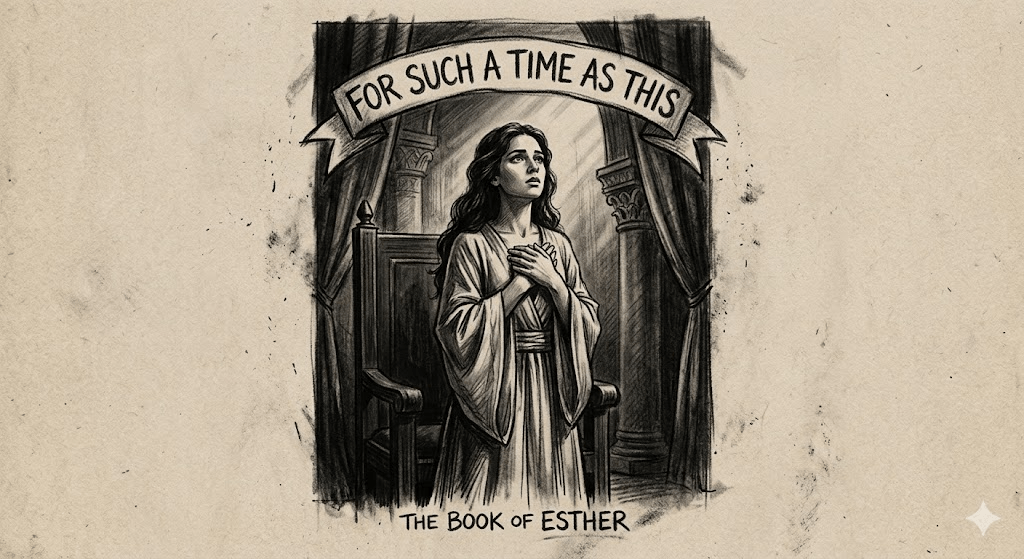
God’s Victory will Prevail
The Message from Mordecai: A Call to Purpose
When Haman’s decree threatened the Jews, Mordecai sent word to Queen Esther via Hathak. He instructed her to enter the King’s presence to beg for mercy on behalf of her people.
The Great Risk: The Law of the Court
Esther sent back a reminder of the law: anyone—man or woman—who approaches the King in the inner court without being summoned is put to death, unless the King extends his gold scepter. She noted that it had been thirty days since she was last called.
The Turning Point: The Sovereignty of God
Mordecai’s response was a sobering challenge:
“Do not think that because you are in the palace, you alone will escape. If you remain silent, deliverance for the Jews will arise from elsewhere, but you and your family will perish. Who knows but that you have come to your royal position for such a time as this?”
The Resolve of Faith: “If I Perish, I Perish”
Esther accepted her calling, requesting that all Jews in Susa fast for three days, night and day, alongside her and her attendants. Her final resolve was a testament to her faith: “I will go to the king, even though it is against the law. And if I perish, I perish.”
The Theology of the Fast: Not by Might, but by Spirit
Esther’s request for the Jews of Susa and her servants to fast was a profound act of humility and corporate intercession. She recognized that while she was the one physically walking into the King’s court, the true victory would be won in the spiritual realm. This creates a powerful biblical arc from the Law and the Prophets to Paul’s Epistles.
1. Acknowledging Human Limitation (The Old Testament Context)
Esther knew that Haman’s decree was legally “unchangeable” by Persian law. By calling for a fast, she was applying the principle found later in the prophets:
- Zechariah 4:6: “‘Not by might nor by power, but by my Spirit,’ says the Lord Almighty.”
- The Connection: Esther moved the focus away from her own influence and placed the burden of deliverance on God’s sovereignty.
2. Strength in Weakness (The Pauline Connection)
The Apostle Paul is particularly insightful. Esther’s “If I perish, I perish” is the Old Testament precursor to Paul’s theology of sacrificial service. She understood that her life was secondary to God’s plan.
- 2 Corinthians 12:9: “But he said to me, ‘My grace is sufficient for you, for my power is made perfect in weakness.’”
- The Connection: Just as Paul boasted in his infirmities so that Christ’s power could rest on him, Esther stripped herself of her royal comforts through fasting so that God’s power could go before her.
3. The Power of Corporate Prayer (The New Testament Reality) Esther did not face the crisis alone; she called the entire community to fast and pray. This mirrors the early church’s response in Acts 12:5: “So Peter was kept in prison, but the church was earnestly praying to God for him.” Esther understood that there is a unique spiritual “strength in numbers.” When the body of believers unites in one spirit, the “impossible,” whether it be Peter’s chains falling off or a King’s heart changing, begins to happen.
- The Servant-Queen: Hidden Leadership Though Esther wore the crown, she never acted as the source of the power. By calling for a corporate fast, she moved herself out of the spotlight and placed the focus entirely on the God of Israel and the collective faith of her people. This “hidden” leadership—where the leader works with and for the people rather than above them—is a recurring theme that ties the entire biblical narrative together.
- The Final Victory: Strength in Weakness. Ultimately, across both Testaments, we see that true victory is never won by human hands alone. Through her resolve, Esther demonstrated a spirit of faith that mirrors the Apostle Paul’s writings: she chose to be small so that God could be great. By surrendering her safety, she found her divine purpose—proving that when we are at our weakest and most dependent on prayer, God is at His most powerful
From Fasting to Favor: Esther’s Royal Appeal
The Approach of Faith
After three days of fasting, Esther adorned herself in her royal robes and stood in the inner court. Though she risked death by appearing uninvited, the King looked upon her with favor and extended the gold scepter. As she touched the tip of the scepter, the King offered to grant her any request—even up to half the kingdom.
The Strategy of the Banquet
Rather than revealing her plea immediately, Esther invited the King and Haman to a banquet she had prepared. During the feast, the King pressed her again for her true petition. With calculated wisdom, Esther delayed her answer once more, inviting them to a second banquet the following day.
The Insight: Esther’s delay was not a sign of fear, but of divine timing. By waiting, she allowed space for God to move in the King’s heart—leading to the providential events involving Mordecai’s honor that very night—before she exposed Haman’s plot.
Wisdom and Patience
This section illustrates a vital spiritual principle found throughout the Bible: Wisdom is the companion of Faith.
- Proverbs 21:1: “In the LORD’s hand the king’s heart is a stream of water that he channels toward all who please him.”
- The Connection: Esther’s success in the court proves that while she did the preparation, it was God who moved the King’s heart. Her patience mirrors the New Testament exhortation in James 1:4 to “let perseverance finish its work so that you may be mature and complete.”
The three days of fasting in Susa serve as a powerful foreshadowing of the Gospel. Just as Esther stood in the gap for her nation, Christ stood in the gap for the world. Her ‘third day’ appearance before the King—marked by favor instead of death—prefigures the Resurrection, where life swallowed up death. Even the suspense of the two-day banquet reminds us that God’s timing is worth the wait; His wisdom is deeper than our urgency, and His victory is always worth the patience required to see it through.
The Power of the Third Day
The “three days” in Susa were not merely a countdown; they were a transition from death to life. This creates a divine “arc” that spans the entire Bible.
1. The Shadow of the Resurrection
The Verse: “He was buried, that he was raised on the third day according to the Scriptures.” (1 Corinthians 15:4)
Just as Esther was, in a sense, “sentenced to death” the moment she decided to enter the court, her emergence on the third day in royal robes mirrors the Resurrection.
The Parallel: Esther risked her life to save her people from a decree of death. Christ gave His life to save humanity from the decree of sin. Both emerged on the third day to claim a victory that had already been won in the spiritual realm.
2. The Weight of the Wait (Wisdom and Suspense)
The King had to wait two more days during the banquets. This “divine delay” is where faith is tested and God’s timing is perfected.
- Human Perspective: For the Jews in Susa, those extra days of banqueting while the decree of death still hung over them must have felt like an eternity.
- Divine Perspective: In that waiting period, God was busy. He kept the King awake at night to read the chronicles, reminding him of Mordecai’s loyalty (Esther 6:1).
- The Connection: Just as the disciples waited in silence between the Cross and the Empty Tomb, the “wait” in Esther’s story shows that God is often at His most powerful when He seems silent.
3. From Rags to Royal Robes
Esther began the three days in sackcloth and ashes (spiritually) and ended them in royal robes.
The Transformation: This mirrors the transition from the “Old Man” to the “New Man” in Paul’s writings. Through the “fast” of the cross, Christ exchanged our rags of sin for robes of righteousness.
Pride Before the Fall: The Great Reversal
Haman’s Boasting and the Gallows
Despite his vast wealth and royal favor, Haman’s heart was consumed by rage because Mordecai the Jew refused to bow. At his wife Zeresh’s suggestion, Haman built a 75-foot pole (fifty cubits) to impale Mordecai, intending to ask the King for his execution the very next morning.
The Sleepless King and Divine Timing
That same night, “coincidentally,” the King could not sleep. He ordered the royal chronicles to be read, which “just happened” to include the account of Mordecai saving the King’s life from an assassination plot. Realizing Mordecai had never been honored, the King looked for someone to rectify the oversight.
The Humiliation of Haman
Haman entered the court at that exact moment to request Mordecai’s death. Instead, the King asked him, “What should be done for the man the king delights to honor?” Thinking the King meant him, Haman proposed a lavish parade in royal robes on the King’s own horse.
In a moment of divine irony, the King commanded: “Go at once… do just as you have suggested for Mordecai the Jew.” Haman was forced to lead his enemy through the streets, proclaiming Mordecai’s greatness.
The Warning of Ruin
Haman rushed home in grief. His own advisors and wife, seeing the shift in momentum, gave him a chilling prophecy:
“Since Mordecai… is of Jewish origin, you cannot stand against him—you will surely come to ruin!”
The Sovereign Hand
This section demonstrates that while Haman was building gallows, God was building a throne of honor.
- Proverbs 16:18: “Pride goes before destruction, a haughty spirit before a fall.”
- The Connection: Haman’s arrogance blinded him. Like the enemies of Christ who thought the Cross was a defeat, Haman didn’t realize that his own “plan” was being used to facilitate his downfall and the hero’s exaltation.
- The Pauline Echo: In Philippians 2:9, Paul writes that because of Christ’s humility, God “exalted him to the highest place.” We see the shadow of this here: Mordecai (the humble servant) is exalted, while Haman (the proud) is humiliated.
Haman’s ‘Braggers Rights’ became his death warrant. This part of the story proves that even when the enemy is busy plotting our destruction, God is busy moving the hearts of kings and keeping them awake to ensure justice is served. The ‘third day’ victory of Esther is now manifesting in the public exaltation of Mordecai—a reminder that God’s timing is never late.
The Two Parades: Royal Honor vs. Messianic Humility
There is a profound “arc” between these two moments. In Susa, we see a physical reversal of status; in Jerusalem, we see a spiritual revolution.
1. The Symbol of the Steed
In the Book of Esther, the horse represents worldly power and royal vindication. Haman suggested the horse because he lusted for the King’s status. When Mordecai was robbed and mounted, it was a public declaration that the King’s authority now rested on the man Haman tried to kill.
- The Result: The enemy (Haman) was forced to proclaim the hero’s honor, and his rage began to turn into “grief” and “ruin.”
2. The Symbol of the Donkey
When Jesus entered Jerusalem, He intentionally chose a donkey—a beast of burden. This fulfilled the prophecy of Zechariah 9:9, which connects back to your earlier point about the prophets:
“See, your king comes to you, righteous and victorious, lowly and riding on a donkey.”
- The Contrast: Mordecai rode a horse to show he was honored by a King. Jesus rode a donkey to show He was a King who serves.
3. The Boiling Point of the Enemy
The enemies’ reactions in both stories are identical. Just as Haman was filled with “rage” and “grief” seeing Mordecai honored, the Pharisees and teachers of the law were indignant when they saw the crowds celebrating Jesus.
- John 12:19: “So the Pharisees said to one another, ‘See, this is getting us nowhere. Look how the whole world has gone after him!’”
- The Connection: In both cases, the enemy’s anger “boils over” because they realize they are losing control. The very person they plotted to destroy is being lifted up by the hand of God.
The Great Exposure: Judgment at the Banquet
The Queen’s Petition
On the second day of the banquet, the King asked Esther for the third time to name her request. With poise and gravity, Esther finally revealed her heart: “Grant me my life—this is my petition. And spare my people—this is my request.” She explained that they had been sold to be annihilated, noting that if they were merely sold as slaves, she would have remained silent to avoid troubling the King.
The Identification of the Enemy
In this final act, outraged, King Xerxes demanded to know, “Who is he? Where is he—the man who has dared to do such a thing?”
Esther’s response was direct and devastating: “An adversary and enemy! This vile Haman!”
The Irony of the Gallows
As the King stepped into the garden in a rage, Haman stayed behind to beg Esther for mercy. In his desperation, he fell upon her couch just as the King returned. Misinterpreting Haman’s posture as an assault on the Queen, the King’s sentence was immediate.
Harbona, the King’s eunuch, pointed out the 75-foot pole Haman had built for Mordecai—the very man who had saved the King. The King gave the final order: “Impale him on it!” Haman was executed on the very instrument he designed for the innocent, and the King’s fury was finally stilled.
The Ultimate Reversal
This moment serves as a powerful type of victory won at Calvary. It illustrates that the weapons formed against God’s people often become the means of the enemy’s own destruction.
- The Trap of the Enemy: Haman built a pole for Mordecai, but he was the one who hung upon it. This mirrors the spiritual reality of the Cross. Satan intended the Cross to be the execution of the Son of God, but God turned it into the execution of Satan’s power.
- Psalm 7:15-16: “Whoever digs a hole and scoops it out falls into the pit they have made. The trouble they cause recoils on them; their violence comes down on their own heads.”
- The Connection: Just as the “sentence of death” was removed from the Jews the moment Haman was judged, the “sentence of death” (the Law’s condemnation) was nailed to the Cross, as Paul describes in Colossians 2:14-15:
“He canceled the charge of our legal indebtedness… he took it away, nailing it to the cross. And having disarmed the powers and authorities, he made a public spectacle of them, triumphing over them by the cross.”
In this final act, we see that God’s justice is not only swift but also poetic. Haman’s pride didn’t just lead to a fall; it led to his own gallows. This is the ‘Triumph of Faith’ in its fullest sense: the enemy’s weapon of death becomes God’s instrument of deliverance. Much like the ‘third day’ of the Resurrection, the moment that looked like the end for the Jews was the beginning of their freedom and the total ruin of their adversary
The King’s Edict… Becomes Our Victory through the King of Kings
The New Decree: From Death to Life A Transfer of Authority. Following Haman’s death, King Xerxes gave his estate to Queen Esther and his signet ring to Mordecai. This was not just a gift of wealth, but a total transfer of power. Mordecai, the man who once sat in sackcloth at the gate, now stood in the presence of the King as his highest official.
The Irrevocable Law
Despite Haman’s death, his original decree of destruction remained “unrevocable” by Persian law. Esther fell at the King’s feet, weeping for her people. In response, the King granted Mordecai the authority to write a new decree. While the first law could not be deleted, the new law gave the Jews the legal right to assemble, protect themselves, and overcome their attackers.
The Message of Victory
Mounted couriers on the King’s fastest horses carried the new edict to 127 provinces. The news transformed Susa and every city it reached. Mordecai emerged in royal garments of blue, white, and purple, wearing a crown of gold. What began as a season of mourning ended in “happiness and joy, gladness and honor.”
The Pauline Connection: A New Law of the Spirit
title, “The King’s Edict… Becomes Our Victory through the King of Kings,” perfectly mirrors a core New Testament teaching found in Paul’s letters.
- The Conflict of Two Laws: In the Book of Esther, the “Law of Death” (Haman’s decree) was countered by the “Law of Life” (Mordecai’s decree). This is exactly how Paul describes our salvation.
- Romans 8:2: “For the law of the Spirit of life in Christ Jesus has set you free from the law of sin and death.”
- The Signet Ring and the Holy Spirit: Just as Mordecai used the King’s ring to seal the new decree of life, Paul teaches that believers are sealed with the Holy Spirit.
- Ephesians 1:13: “In him you also… were sealed with the promised Holy Spirit, who is the guarantee of our inheritance.”
“The story of Esther concludes with a legal triumph that foreshadows our own. We were once under a ‘decree of death’ because of sin, but the King of Kings has issued a new edict. By the ‘Signet Ring’ of the Holy Spirit, we have been given the authority to stand against the enemy and claim our inheritance. Mordecai’s royal robes and the Jews’ joyous feasting are the Old Testament picture of the ‘garments of praise’ that belong to every believer today. God’s Victory has indeed prevailed.“
The Turning of the Tables: Victory and Remembrance
The Day of Deliverance
On the thirteenth day of Adar—the very day the enemies of the Jews hoped to annihilate them—the “tables were turned.” Empowered by the King’s second edict and the rising influence of Mordecai, the Jews successfully defended themselves against those who sought their ruin. In a show of restraint and integrity, though they were permitted to plunder, the text emphasizes that they did not lay their hands on the spoil.
The Destruction of the House of Haman
In the citadel of Susa, the victory was absolute. Esther requested that Haman’s ten sons also be impaled on poles, ensuring that the “vile” legacy of their father was completely cut off. This act was not about vengeance, but about the total uprooting of the evil scheme that had threatened the nation. Esther corrected the sin of Saul therefore redeeming the people of Isreal
The Establishment of Purim
What began as a month of “sorrow and mourning” was transformed into a season of “joy and celebration.” To ensure that future generations never forgot God’s providence, Mordecai and Queen Esther established the Festival of Purim (named after the Pur, or lot, that Haman had cast). It was decreed as an annual time of:
- Feasting and Joy: Celebrating the relief from their enemies.
- Generosity: Sending gifts of food to one another.
- Charity: Giving gifts to the poor.
From the Lot to the Lord
The transition from Haman’s “lot” to God’s “joy” provides a fitting conclusion to our study, linking Old Testament history to the New Testament’s eternal victory.
- The Sovereignty of God: Haman used “Pur” (chance) to decide the Jews’ fate. But as Proverbs 16:33 says, “The lot is cast into the lap, but its every decision is from the Lord.” This proves your opening title: God’s Victory will Prevail.
- The Transformation of Sorrow: Mordecai’s letter describes sorrow turning into joy. This mirrors the promise Jesus gave His disciples before the Cross:
John 16:20: “You will weep and mourn while the world rejoices. You will grieve, but your grief will turn to joy.”
- The Legacy of Remembrance: Just as Purim was established to remember the deliverance in Susa, the Lord’s Supper was established for us to remember the deliverance at Calvary. Both are communal celebrations of a victory won by a mediator standing before a King.
“The Book of Esther ends not with a funeral, but with a feast. The ‘Pur’, the lot of destruction, was overruled by the ‘Purpose’ of God. By establishing Purim, Esther and Mordecai ensured that the memory of God’s faithfulness would live forever. For us, this serves as a final reminder: no matter what ‘lot’ the enemy casts against you, the King has issued a new decree. Your mourning is destined to turn into dancing, and your sorrow into a day of celebration. The victory is won.”
Conclusion: The Eternal Echo of Susa
The Book of Esther stands as a unique masterpiece in the biblical canon—a story where God’s name is never spoken, yet His fingerprints are found on every page. From the “chance” sleeplessness of a King to the “coincidental” timing of a banquet, we see that what the world calls luck, the believer calls Providence.
Ultimately, Esther’s story reminds us that we do not serve a distant or disinterested God. We serve a King who:
Turns the enemy’s gallows into the believer’s victory.
Hears the silent fast of the humble.
Overrules the irrevocable laws of our past.
Closing Prayer
Heavenly Father,
We thank You that even when You are silent, You are never absent. We thank You for the courage of Esther and the steadfastness of Mordecai, which remind us that our lives have a divine purpose “for such a time as this.”
Lord, we ask that You would give us the spirit of discernment to recognize the “New Decree” You have written over our lives. May we walk in the authority of the King of Kings, knowing that the gallows intended for our destruction have been transformed into a platform for Your glory. Turn our mourning into dancing and our sorrow into the joy of Your salvation.
In the mighty name of Jesus, who blessed us with his Grace,
Amen.
Tomas The-Way.blog
© 2026 The-Way.blog | Tomas. All Rights Reserved.
References & Scholarly Sources
Biblical Commentary & Hermeneutics
- Bush, F. W. (1996). Ruth-Esther (Word Biblical Commentary, Vol. 9). Dallas: Word Books. (Explores the literary “reversal” motifs and chiastic structure).
- Baldwin, J. G. (1984). Esther: An Introduction and Commentary. Tyndale Old Testament Commentaries. (Analysis of Persian legal structures and the role of the mediator).
- Keil, C.F. & Delitzsch, F. Commentary on the Old Testament. (Historical context regarding the “Third Day” and the establishment of Purim).
Theological Themes
- Duguid, I. M. (2005). Esther and Ruth (Reformed Expository Commentary). P&R Publishing. (Connecting the “hiddenness” of God in the Old Testament to the revelation of Christ).
- Jobes, K. H. (1999). The NIV Application Commentary: Esther. Zondervan. (Focuses on the providential timing of God in the life of the believer).
Key Scriptural Foundations
The Third Day Typology: 1 Corinthians 15:3–4, Jonah 1:17.
Sovereignty: Proverbs 16:33, Proverbs 21:1.
The Law of the Spirit: Romans 8:1–2, Colossians 2:13–15.
Biblical Footnotes & Cross-References
- Note 1: On Human Limitation and Divine Spirit. The principle of “Not by might” (Zechariah 4:6) serves as the theological foundation for Esther’s fast. It highlights the transition from reliance on royal influence to reliance on the Ruach (Spirit) of God.
- Note 2: The “Third Day” Typology. Esther’s appearance before the King on the third day (Esther 5:1) is historically recognized by scholars as a “type” or “shadow” of the Resurrection. Just as Jonah was three days in the belly of the fish (Jonah 1:17) and Christ was raised on the third day (1 Corinthians 15:4), Esther’s “resurrection” from a death-decree brings life to her people.
- Note 3: The Theology of Substitution. The gallows built by Haman (Esther 7:9-10) represent the biblical theme of “poetic justice” and substitutionary atonement. As Haman died on the gallows he built for the innocent Mordecai, Paul explains in Galatians 3:13 that Christ “became a curse for us” to remove the sentence of death.
- Note 4: The Conflict of the Two Laws. The inability to revoke the first decree (Esther 8:8) mirrors the “Law of Sin and Death” which requires a penalty. Mordecai’s second decree does not delete the first but provides the means to overcome it, paralleling the “Law of the Spirit of Life” in Romans 8:2.
- Note 5: The Seal of Authority. The King’s Signet Ring (Esther 8:10) is the physical manifestation of delegated authority. In New Testament theology, this is mirrored by the “Seal of the Holy Spirit” (Ephesians 1:13-14), which acts as the believer’s guarantee of inheritance and protection.
- Note 6: The Great Reversal (Peripeteia). The “turning of the tables” in Esther 9:1 is a literary and theological device known as peripeteia. This aligns with the Magnificat of Mary in Luke 1:52: “He has brought down rulers from their thrones but has lifted up the humble.”
 The-Way
Leave a comment