The Secret Strength of Private Faith: Rebekah (Part 4A)
Good afternoon. Today, we continue our series, The Secret Strength of Private Faith, by looking at the journey of Rebekah.
How often is your faith tested? These tests happen more frequently than we imagine, often striking at the very core of who we are. Recently, I watched a series called Married at First Sight. While the show uses “experts” and algorithms to match people—often with extreme results—Rebekah’s story was the original “blind” commitment. However, unlike a television contract, her “yes” was rooted in a spiritual vision: The-Way.
Setting the Stage: A Servant’s Concern
The Covenant (Genesis 24:2–4) Abraham was strict in his requirements for finding a wife for his son, Isaac. He made his oldest servant swear by the Lord that he would not choose a wife from the Canaanites but would instead return to Abraham’s own kindred.
The Reality Check (Genesis 24:5) The servant, practical in his thinking, asked: “Perhaps the woman may not be willing to follow me… Must I then take your son back to the land from which you came?”
The-Way (Genesis 24:7) Abraham’s response was rooted in absolute confidence:
“The Lord… who spoke to me and swore to me… He will send His angel before you, and you shall take a wife for my son from there.”
The servant’s faith became strong because he stood on the shoulders of Abraham’s faith. He trusted The-Way to guide human decisions.
The Importance of Consent: The “Yes” Factor (Genesis 24:8) Even in this divine mission, human will mattered. Abraham told his servant, “If the woman is not willing to follow you, then you will be free from this oath.” For a covenant to be valid, there must be a “YES.”
The Prayer at the Well: Seeking a Sign
Today, we have cell phones, social media, and television to receive the news. However, during ancient times, the social hub was the well. After the long journey from Canaan to Mesopotamia, the servant arrived at the outskirts of the city of Nahor. He stopped at a well in the evening, when women came out to draw water.
Genesis 24:12–14 The servant prayed for a specific sign: “Let the young woman to whom I shall say, ‘Please let down your jar that I may drink,’ and who shall say, ‘Drink, and I will water your camels also’—let her be the one.”
The Logistics of Service Think about the weight of this request. A thirsty camel can drink up to 25 gallons of water. The servant had ten camels. To fulfill this sign, a woman wouldn’t just be polite; she would be committing to the back-breaking task of drawing over 250 gallons of water for a complete stranger.
Secret Strength: A Test of Character
Genesis 24:15–21 Before the servant finished praying, Rebekah appeared. She was kind and hospitable, but more importantly, she was industrious. When asked for a drink, she didn’t just satisfy the man; she volunteered to water all ten camels until they were finished.
The man watched her in silence, amazed. Her “secret strength” was her initiative. Before Rebekah knew a marriage proposal was on the horizon, she was already the kind of person who would go above and beyond for a stranger. Her private faith had already built the physical and spiritual muscles she would need for the journey ahead.
The-Way in the Everyday: The Strangers in Our Home
Rebekah’s “secret strength” was that she didn’t pick and choose when to be a servant—she simply was one. Her hospitality wasn’t a mask she put on for guests; it was the natural overflow of her character. This brings us to a challenging reflection on The-Way in our own lives: How often do we turn our eyes away from a “stranger” in need?
Often, that “standard” stranger isn’t a person on the street; it is the person in the next room. It is the family member or friend we have come to take for granted.
I experienced a “well moment” of my own while writing this. I had to pause because my daughter needed my help. Instead of responding with the same “Secret Strength” I was admiring in Rebekah, I felt the friction of interruption. I was frustrated. In that moment, I realized that it is easy to pray for the strength to help the world, but much harder to find the grace to help our own.
In The-Way, the physical and spiritual muscles we build are tested most acutely at home. If we cannot serve those we love without complaint, how can we expect to be ready when the “Servant at the Well” arrives with a life-changing request? The stranger we fail to help is often the family member we have stopped seeing with eyes of faith.
Revelation of Faith (Genesis 24:23–28)
When the servant realized Rebekah was indeed from Abraham’s kindred, he bowed his head and worshiped:
“Blessed be the Lord… who has not forsaken his steadfast love… the Lord has led me in the way.”
Rebekah, seeing the hand of God at work, ran to tell her household. The journey of faith had officially begun.
The Radical Departure: Crossing the Point of No Return
In our modern world, we have GPS, photos of our destination, and the ability to video call home. Rebekah had none of that. When she said “I will go,” she was essentially stepping off the edge of her known world.
The Decisive “Yes” (Genesis 24:58–59) “And they called Rebekah and said to her, ‘Will you go with this man?’ She said, ‘I will go.’ So they sent away Rebekah their sister and her nurse, and Abraham’s servant and his men.”
In The-Way, discernment isn’t just about knowing the right path; it’s about the courage to walk it. Rebekah’s journey was approximately 500 miles—a trek that would take weeks across harsh terrain.
I’ll be honest: I sometimes have a hard time just walking through the mall or taking a stroll in the Texas heat at a local park. When I feel that afternoon sun, I think of Rebekah. She didn’t have an air-conditioned car or a paved path. She left everything familiar to travel across a wilderness to meet a man she had never seen. Her “I will go” was a physical manifestation of her private faith.
Leaving the Comfort of Home for the Unknown
She left the house of her father, Bethuel, and her brother, Laban. She no longer had her family’s protection. Rebekah traded a settled life for a nomadic one in a land she had never seen, leaving her security behind. She moved from being “the daughter of the household” to being the “matriarch of a promise.”
The Long Silence of the Journey We often gloss over the weeks spent on the back of a camel. Imagine the conversations between Rebekah and the servant during those long desert nights. This was her “orientation” into the faith of Abraham. She wasn’t just traveling toward a husband; she was traveling toward a God she was just beginning to know.
Reflection: The Private Preparation
Rebekah could say “I will go” so decisively because she had already been practicing The-Way in her daily life. Her physical stamina at the well prepared her for the physical toll of the journey. Her spiritual discernment allowed her to recognize that the servant’s arrival was not a coincidence, but a calling.
Lean into your own heart and listen to the calling of The-Way and follow the Lord Jesus Christ.
The Meeting in the Field: When Preparation Meets Destiny
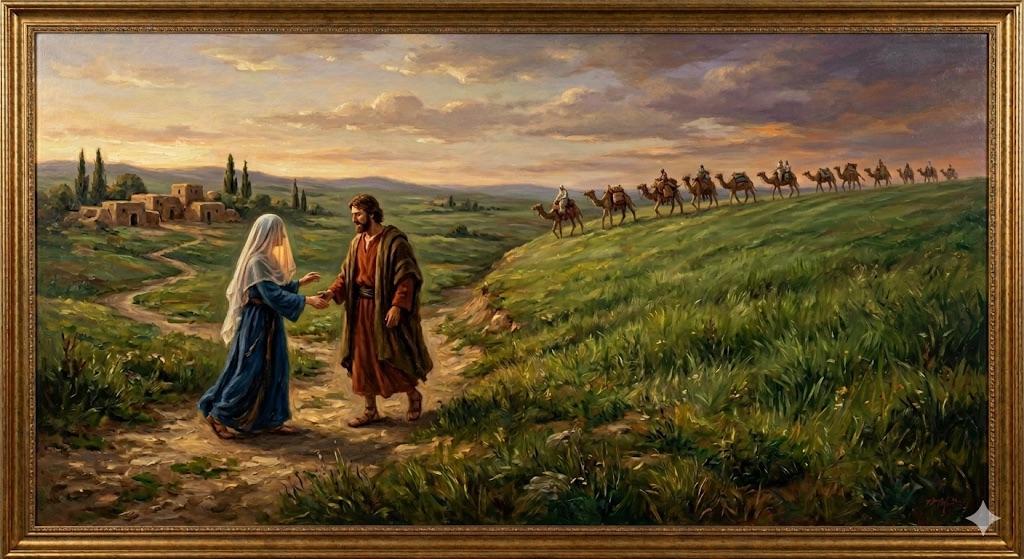
The long journey across the desert finally nears its end. The dust of the road begins to settle, and the Negev landscape opens up before Rebekah. This is the climax of her “blind” commitment—the moment she finally sees the man for whom she left everything.
A Shared Spiritual Vision (Genesis 24:63–64) “And Isaac went out to meditate in the field toward evening. And he lifted up his eyes and saw, and behold, there were camels coming. And Rebekah lifted up her eyes, and when she saw Isaac, she dismounted from the camel…”
In The-Way, it is no coincidence that both Isaac and Rebekah were “lifting up their eyes” at the same moment. Isaac was in a state of meditation and prayer, and Rebekah was watchful. Their union begins not in a crowded city, but in a quiet, open space of reflection.
The Strength of the Veil (Genesis 24:65) “She said to the servant, ‘Who is that man, walking in the field to meet us?’ The servant said, ‘It is my master.’ So she took her veil and covered herself.”
Rebekah’s decision to veil herself is a profound act of discernment and respect. The veil marks the boundary between her past life in Haran and her future as Isaac’s wife. Even in her vulnerability, Rebekah maintains her dignity. She isn’t just “being delivered” like a package; she is actively participating in the customs and the sacredness of the moment.
From Grief to Comfort (Genesis 24:67)
“Then Isaac brought her into the tent of Sarah his mother and took Rebekah, and she became his wife, and he loved her. So Isaac was comforted after his mother’s death.”
This is the beautiful resolution of her journey. Rebekah doesn’t just fill a role; she brings healing. Her presence is so strong that it bridges the gap left by the death of the great matriarch, Sarah.
A Prayer for the Journey
“Heavenly Father,
As we walk further into Rebekah’s story, we ask for eyes that see beyond the surface. Grant us the Secret Strength to handle the ‘well moments’ in our own lives—the interruptions, the heavy lifting, and the needs of those closest to us—with a heart of service rather than a spirit of frustration.
Lord, guide our hearts in The-Way. May we build the spiritual muscles today that we will need for the unknown journeys of tomorrow. Help us to be as bold in our ‘Yes’ as Rebekah was, and as attentive to Your voice in the quiet of our homes as we are in the presence of others.
Bless the writing, bless the reading, and let these words lead us closer to Your truth. Amen.” Tomas
Footnotes
[^1]: Genesis 24:10-14: Historical context suggests that the “well” served as the primary social and communal center of ancient Near Eastern towns. [^2]: Camel Hydration: A Bactrian or Dromedary camel can consume nearly 30 gallons of water in 13 minutes. Watering ten camels would require drawing approximately 250–300 gallons. [^3]: The Distance: The journey from Haran (Mesopotamia) to the Negev (Canaan) is estimated to be between 450 and 500 miles, requiring significant physical endurance. [^4]: The Veil: In ancient Near Eastern custom, the veil symbolized a transition of status and a mark of modesty during the first meeting of a betrothed couple.
Resources & Bibliography
- The Holy Bible, English Standard Version (ESV).
- Alter, Robert. The Art of Biblical Narrative. Basic Books, 2011. (Provides insight into the structure of the “Betrothal Type-Scene” in Genesis).
- Matthews, Victor H. Manners and Customs in the Bible. Hendrickson Publishers, 2006. (Details regarding ancient wells and travel logistics).
Sarna, Nahum M. The JPS Torah Commentary: Genesis. Jewish Publication Society, 1989. (Analysis of the legal and covenantal aspects of Abraham’s servant’s oath).
 The-Way
Leave a comment