Receiving the Word of God
The Big Picture
Luke intentionally structured this chapter to ask a massive question. The first half introduces us to those who are listening to Him, using the spoken word to show how we should understand the truth. The second half shifts to raw power, proving exactly why He is worth listening to.
Introduction: The Women Who Walked with Jesus (Luke 8:1–3)
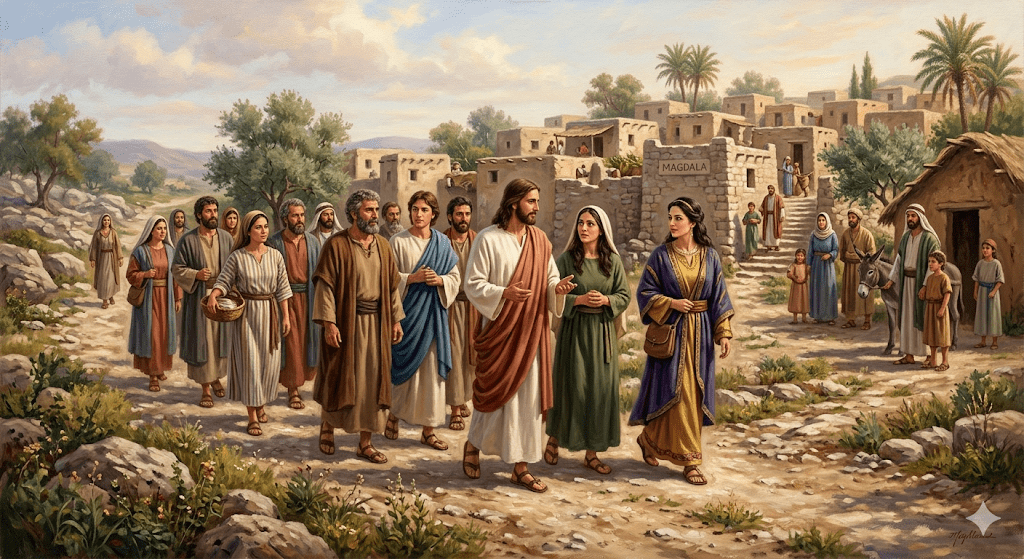
Luke opens this chapter by highlighting a group of women who had been healed of diseases and evil spirits. They traveled alongside Jesus and the twelve apostles, radically breaking the cultural boundaries of the day to become primary pillars of His ministry.
- Mary Magdalene: Specifically highlighted as someone from whom seven demons had been cast out. Her profound deliverance fueled a fierce loyalty. She would walk with Jesus all the way to the cross, discover the empty tomb, and become the very first person commissioned by Jesus to announce the resurrection—effectively making her the “apostle to the apostles.”
- Joanna: The wife of Chuza, the household manager of Herod Antipas (the tetrarch responsible for beheading John the Baptist). This historical connection is stunning: while Herod was opposing God’s kingdom, his own manager’s wife was privately funding it. Joanna remained so faithful that she was also among the first women at the empty tomb on Easter morning (Luke 24:10).
- Susanna and Many Others: Women of means who chose to use their personal resources to financially support and sustain Jesus and His disciples during their travels.
Application ✜ : Before Jesus even delivers the Parable of the Sower, these women serve as the ultimate real-world example of “good soil.” They listened to Him, walked with Him, funded His ministry, and ultimately became the primary witnesses of His resurrection.
Part 1: Receiving the Word of God
Building on the example of these faithful women, the next three sections focus heavily on spiritual reception—how we listen to, retain, and live out Jesus’s teachings.
- 1. The Parable of the Sower (Luke 8:4–15)
Jesus describes four types of soil (representing human hearts) reacting to seed (the Word of God). Only the good soil, which hears the word and holds it fast, produces a harvest.
- 2. A Lamp Under a Jar (Luke 8:16–18)
A brief but powerful analogy: light isn’t meant to be hidden; truth is meant to be exposed and shared. This reinforces the Sower parable by showing that if you have truly received the “seed,” your light will naturally shine.
- 3. Jesus’ True Family (Luke 8:19–21)
When Jesus’ mother and brothers come to see Him, He redefines family boundaries by stating, “My mother and my brothers are those who hear the word of God and do it.” This ties a neat bow on the theme of the first three sections.
Part 2: Demonstrating Divine Authority
The chapter then shifts from words to raw power, proving that Jesus isn’t just a great teacher—He holds absolute authority over every facet of existence.
- 4. Jesus Calms the Storm (Luke 8:22–25) | Authority over Nature
Terrified disciples wake a sleeping Jesus during a furious gale. With a single command, He rebukes the wind and raging waters, leaving the disciples asking, “Who then is this, that he commands even winds and water, and they obey him?”
- 5. The Demon-Possessed Man (Luke 8:26–39) | Authority over the Spiritual Realm
Traveling to the region of the Gerasenes, Jesus encounters a man oppressed by a “Legion” of demons. Mirroring the complete deliverance He gave to Mary Magdalene, Jesus casts the demons into a herd of pigs, fully restoring the man’s sanity, dignity, and purpose.
- 6. A Dead Girl Raised & A Sick Woman Healed (Luke 8:40–56) | Authority over Sickness and Death
This is a famous “sandwich” story. While Jesus is en route to heal the dying 12-year-old daughter of Jairus, a woman with a chronic blood condition touches the fringe of His garment and is instantly healed. Moments later, word arrives that the young girl has died. Jesus continues to the house, takes her by the hand, and commands her to arise—and her spirit returns.
Closing Summary: The Foundation of Faithful Followership
Luke 8 does not begin with an abstract theological lecture; it begins with a roster of transformed lives. Before Jesus ever defines what “good soil” looks like in a parable, Luke shows us Mary Magdalene, Joanna, and Susanna living it out. These women were not passive bystanders in first-century Palestine; they were active partners, financial patrons, and the ultimate historical anchors of the resurrection story. By highlighting them, Luke sets a profound standard for what it means to hear the Word of God and immediately put it into practice.
Call to Action ✜
Take a moment today to reflect on your own resources, talents, and testimony. Like the women who walked with Jesus, how can you use what God has uniquely given you—whether it is your financial means, your daily influence, or your personal story of deliverance—to actively support the work of His kingdom in your community?
A Short Prayer
Lord, thank You for Your radical invitation to follow You, breaking through every cultural and social barrier to bring us into Your family. Give us hearts like good soil. Fill us with the fierce loyalty of Mary, the bold devotion of Joanna, and the generous spirit of Susanna. May we not only listen to Your Word but actively sustain and proclaim it with our lives as we follow in The-Way of Jesus Christ. Amen.
─── Tomorrow, we will dive into Part 1 and see the exact teaching that inspired these women to change the world. ───
Tomas The-Way.blog
© 2026 The-Way.blog Digital Publications. All Rights Reserved.
Deep Dive: Scholarly Resources & Footnotes
For those who want to conduct further biblical research on the historical and cultural impact of these women, the following academic resources and cross-references provide an excellent starting point:
1. Biblical Cross-References
- The Burial and Resurrection Witnesses: Compare Luke 8:1–3 with Luke 23:55–24:11, Matthew 27:55–56, and Mark 15:40–41. Note how these identical groups of women form the continuous eyewitness link between Christ’s death, burial, and resurrection.
- Mary Magdalene’s Commission: John 20:11–18. Jesus specifically chooses Mary Magdalene to carry the first news of the ascension to the male disciples, giving rise to her historical title Apostola Apostolorum (Apostle to the Apostles).
- Herod’s Court Connections: Luke 9:7–9 and Luke 23:8. These passages highlight Herod Antipas’s intense curiosity about Jesus’s miracles, likely fueled by reports coming directly from his own household manager, Chuza (Joanna’s husband).
2. Footnotes & Historical Context
- The Rabbinic Context: In first-century Judaism, it was highly unusual and often discouraged for rabbis to accept female disciples. The Talmud (specifically Sotah 21b) reflects some of the stricter cultural attitudes of the era regarding women studying the Torah. Jesus radically upended this cultural norm by inviting women to travel with Him as formal disciples.
- The Role of Patronage (Diakonia): The Greek verb used in Luke 8:3 for “supporting them” is diakoneo, from which we get the word “deacon.” In the Greco-Roman world, wealthy women acting as financial patrons (patronae) was a recognized social practice, but applying it to a wandering religious movement was revolutionary.
3. Recommended Scholarly Reading
- Bauckham, Richard. Gospel Women: Studies of the Named Women in the Gospels (Eerdmans, 2002). Chapter 5 offers an incredibly detailed, world-class historical analysis of Joanna, Chuza, and the court of Herod.
- Witherington III, Ben. Women in the Ministry of Jesus: A Study of Jesus’ Attitudes to Women and their Roles as Reflected in His Earthly Life (Cambridge University Press, 1984). A foundational text examining the socio-cultural boundaries Jesus broke.
- Keener, Craig S. The IVP Bible Background Commentary: New Testament. Provides excellent, quick-reference cultural context on Luke 8:1–3 regarding ancient Jewish and Roman laws on women owning property and managing finances.
Digital Copyright Notice
Copyright © 2026. All Rights Reserved.
This document is protected under international copyright and digital rights management laws.
Fair Use Citation: Short quotations or excerpts used in reviews, essays, or academic papers must provide appropriate attribution referencing the author and title of this work.
Permitted Use: Permission is granted to download, store, electronically view, and print physical copies of this text solely for personal use, private study, small group discussions, or local church ministry settings.
Prohibited Use: No part of this digital publication may be reproduced, redistributed, resold, hosted on public servers, or transmitted in any form or by any means—including photocopying, digital file sharing, recording, or translation into other languages—for commercial purposes without the prior written permission of the copyright holder.
 The-Way
Leave a comment