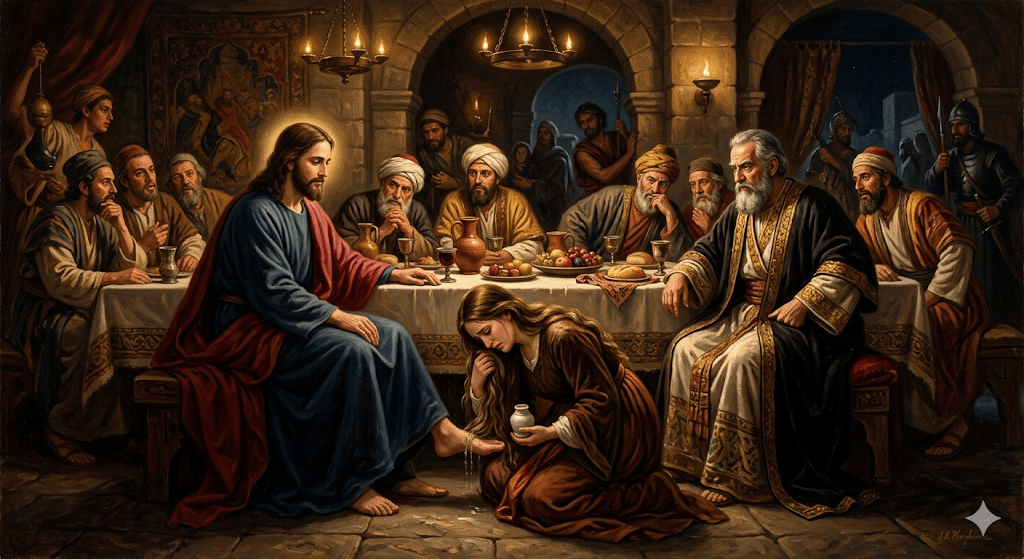
Sorrowful Woman of Faith
Introduction
How quickly are we to judge the people around us based on their worst moments? In a world obsessed with keeping up appearances, it is easy to get caught up in trying to look good for others—even if it means looking down on someone else. But true faith isn’t about maintaining a flawless public image; it is about a gut-honest posture of our hearts before God.
When the cultural distractions clear away, and you are faced with your own brokenness, what does your faith actually look like?
- Do you possess a resolute faith, recognizing the absolute authority of Christ’s word even when the storms of life are raging? So many times, we wither and falter when confronted with trials, yet we are called to a strength that stands firm.
- Are you willing to humble yourself completely, stripping away pride to receive the life-giving grace that meets us in our deepest moments of despair?
- And when doubt creeps in, do you remember that it is okay to ask questions? Even in our wrestling, our anchor must remain firmly held in Christ’s saving grace, not our own perfect understanding.
To see how these different threads of authentic, barrier-breaking faith weave together, we need to look back at the ground we’ve covered so far in Luke 7.
Moving from Public Wonders to Intimate Faith
In our journey through this chapter, we have witnessed Jesus dismantle the conventional boundaries of who is considered “worthy” in the kingdom of God. Each encounter has pushed us deeper into the radical nature of grace, setting the stage for one of the most intimate moments in the Gospels.
- The Faith of the Centurion: We began with a Roman outsider—a man of war and occupation—whose profound understanding of authority and humility caused Jesus to marvel. He reminded us that true faith is not a matter of heritage, but of absolute surrender to Christ’s word.
- The Widow’s Son at Nain: From the military elite, Jesus turned to the most vulnerable. By raising a widow’s only son from the dead, He invaded a scene of ultimate despair, proving that His kingdom brings life where death seems to have the final word.
- A Prophet’s Struggle: This wrestling is why even those closest to the promise can falter. We walked with John the Baptist through the dark valley of doubt, learning that Christ honors our honest questions and answers our uncertainty not with condemnation, but with the undeniable proof of His transforming power.
The Next Step on the Journey
Having seen Jesus amaze a Roman commander, comfort a grieving mother, and reassure a doubting prophet, we now move from public streets and crowded town gates into the quiet tension of a Pharisee’s dinner party. Here, the grand themes of authority, life, and messianic identity narrow down to a single, scandalous act of devotion.
Let’s turn our attention to an unnamed woman, an alabaster jar of perfume, and a scandalous act where the depth of brokenness meets the heights of extravagant love.
Jesus Anointed by a Sinful Woman
Luke 7:36–39
36 When one of the Pharisees invited Jesus to have dinner with him, he went to the Pharisee’s house and reclined at the table. 37 A woman in that town who lived a sinful life learned that Jesus was eating at the Pharisee’s house, so she came there with an alabaster jar of perfume. 38 As she stood behind him at his feet weeping, she began to wet his feet with her tears. Then she wiped them with her hair, kissed them and poured perfume on them. 39 When the Pharisee who had invited him saw this, he said to himself, “If this man were a prophet, he would know who is touching him and what kind of woman she is—that she is a sinner.”
The Modern Parallel
Imagine we are in a meeting with the elders and pastors of a church, and in walks a woman known for living a messy life. She goes straight to the senior pastor, weeping and begging at his feet. What would our reaction be? In most places—if not all—they would call security, or the deacons themselves would escort her out. They might pray for her with very little heart and then send her on her way.
Yet, look at how radically different Jesus’ reaction is.
Luke 7:40–46
40 Jesus answered him, “Simon, I have something to tell you.” “Tell me, teacher,” he said. 41 “Two people owed money to a certain moneylender. One owed him five hundred denarii, and the other fifty. 42 Neither of them had the money to pay him back, so he forgave the debts of both. Now which of them will love him more?” 43 Simon replied, “I suppose the one who had the bigger debt forgiven.” “You have judged correctly,” Jesus said. 44 Then he turned toward the woman and said to Simon, “Do you see this woman? I came into your house. You did not give me any water for my feet, but she wet my feet with her tears and wiped them with her hair. 45 You did not give me a kiss, but this woman, from the time I entered, has not stopped kissing my feet. 46 You did not put oil on my head, but she has poured perfume on my feet.
The Radical Nature of Forgiveness
Jesus answers Simon’s silent judgment not with a harsh rebuke, but with a simple story. This parable pictures two debtors.
The heart of Jesus’ relational ethic is that, unlike the Pharisee, who can only dwell on the sinner’s past record, Jesus prefers to see the potential that love and forgiveness possess for transforming a person’s heart. To prove this, He points out how this woman cared for Him in a way his host completely neglected.
In this ancient culture of honor and shame, it was a severe insult to receive guests improperly (cf. 11:37–38; 14:1). This critical portrayal of Simon the Pharisee (not to be confused with Simon Peter) is entirely consistent with the broader description of the religious elite throughout Luke’s Gospel.
47 Therefore, I tell you, her many sins have been forgiven—as her great love has shown. But whoever has been forgiven little loves little.”48 Then Jesus said to her, “Your sins are forgiven.” 49 The other guests began to say among themselves, “Who is this who even forgives sins?” 50 Jesus said to the woman, “Your faith has saved you; go in peace.
Jesus flips the Pharisee’s logic on its head: her extravagant love isn’t an attempt to earn favor, but the natural overflow of a heart that has already tasted radical forgiveness. There is also an implied warning from Jesus to the Pharisee: “Your love may not be as great because you have not appreciated the depth of forgiveness God has made available to you.” Jesus challenges such a way of looking at sin.
Jesus’ words of forgiveness are also significant. Forgiving sins is an act limited to God, as the Pharisees well know. They know that Jesus is appropriating to himself the ultimate level of authority.
Conclusion: A Faith That Breaks Barriers
Jesus’ final comment reveals a crucial theological sequence first comes the offer of forgiveness from God, followed by the faith that saves. Genuine faith then reveals itself through tangible acts of love, just as this woman demonstrated. This forms the fundamental relationship that exists between God and the believer.
The woman who anoints Jesus’ feet illustrates several foundational truths about faith:
- Overcoming Cultural Barriers: In that culture, it was a massive social risk for a woman to publicly approach a male religious figure so intimately.
- Overcoming Personal Shame: The fact that she was publicly known as a sinner heightened the stakes considerably, as a typical rabbi would have rejected her.
- Extravagant Gratitude: Her humility was so profound that getting close to Jesus was all that mattered. She counted the cost and believed that He would respond to her brokenness with grace.
Jesus honored her faith. Today, we are left with a challenging question: How many of us would be bold enough to identify with Jesus if it meant facing public rejection? Where have we seen people with messy lives and difficult histories display the most beautiful acts of faith?
Summary
Throughout Luke 7, Jesus consistently shatters cultural expectations of righteousness. From a powerful Roman centurion to a grieving widow, and finally to a marginalized woman with a compromised past, Jesus reveals that the kingdom of God belongs to the humble. The religious elite saw a sinner; Jesus saw a transformed heart. Ultimately, her extravagant love was not an attempt to earn salvation, but a beautiful, overflowing response to the radical grace she had already received.
Call to Action
- Examine Your Posture: Are there areas in your life where you act more like Simon the Pharisee—focusing on external appearances and judging the brokenness of others—rather than offering grace?
- Embrace Your Brokenness: Do not let personal shame or fear of public opinion keep you from approaching Jesus. Bring your “alabaster jar” of raw, honest emotion to His feet.
- Love Extravagantly: Reflect on the depth of the debt Christ has forgiven in your own life. Let your daily worship, service, and interactions with others be a natural overflow of that gratitude.
Closing Prayer
Heavenly Father, thank You for a grace that does not demand a flawless public image, but instead meets us in our deepest brokenness. Forgive us for the times we have sat in judgment of others, forgetting the magnitude of the debt You have forgiven in us. Give us the bold, barrier-breaking faith of this woman. May we never be held back by pride or fear of what others think but instead lay our lives at the feet of Jesus in extravagant love. In Jesus’ name, Amen.
Tomas The-Way.blog
© 2026 The-Way.blog Digital Publications. All Rights Reserved.
Biblical References & Cross-References
- Luke 7:1–10 – The Faith of the Centurion (Humility and absolute authority recognized by an outsider).
- Luke 7:11–17 – The Widow’s Son at Nain (Jesus brings life to places of ultimate cultural and emotional despair).
- Luke 7:18–35 – John the Baptist’s Doubt (Jesus answers honest wrestling with proof of His transforming power).
- Luke 11:37–38; 14:1 – Pharisaic hospitality norms and critical interactions with Jesus over cultural customs.
- Matthew 26:6–13; Mark 14:3–9; John 12:1–8 – Parallel/distinct accounts of Jesus being anointed by a woman at a dinner party (noting the historical and theological distinctions between these events).
- Ephesians 2:8–9 – The theological sequence of grace, faith, and salvation leading to good works.
Footnotes & Citations
- Cultural Context of Hospitality: In first-century Jewish hospitality, offering water to wash a guest’s dusty feet, greeting them with a kiss of peace, and anointing their head with basic olive oil were standard marks of honor and respect for an invited guest. Simon’s omissions were a passive-aggressive public snub of Jesus.
- The Value of the Debt: A denarius was equivalent to a standard day’s wage for a laborer. The first debtor owed 500 denarii (nearly two years of wages), while the second owed 50 denarii (less than two months). Both were completely bankrupt and unable to pay, illustrating humanity’s equal inability to settle its spiritual debt before God, regardless of the perceived “size” of their sins.
- The Identity of the Woman: Church tradition has sometimes conflated this unnamed woman with Mary Magdalene (introduced in Luke 8:2) or Mary of Bethany (John 12), but Luke intentionally leaves her anonymous to emphasize her representative status as a “sinful person” transformed by grace.
- Blasphemy and Divine Authority: The murmuring of the guests (“Who is this who even forgives sins?”) directly echoes Luke 5:21. In Jewish theology, sin was an offense against God alone; therefore, claiming the authority to absolve sin on the spot was considered a direct claim to divinity.
Digital Copyright Notice
Copyright © 2026. All Rights Reserved.
This document is protected under international copyright and digital rights management laws.
Fair Use Citation: Short quotations or excerpts used in reviews, essays, or academic papers must provide appropriate attribution referencing the author and title of this work.
Permitted Use: Permission is granted to download, store, electronically view, and print physical copies of this text solely for personal use, private study, small group discussions, or local church ministry settings.
Prohibited Use: No part of this digital publication may be reproduced, redistributed, resold, hosted on public servers, or transmitted in any form or by any means—including photocopying, digital file sharing, recording, or translation into other languages—for commercial purposes without the prior written permission of the copyright holder.
 The-Way
Leave a comment