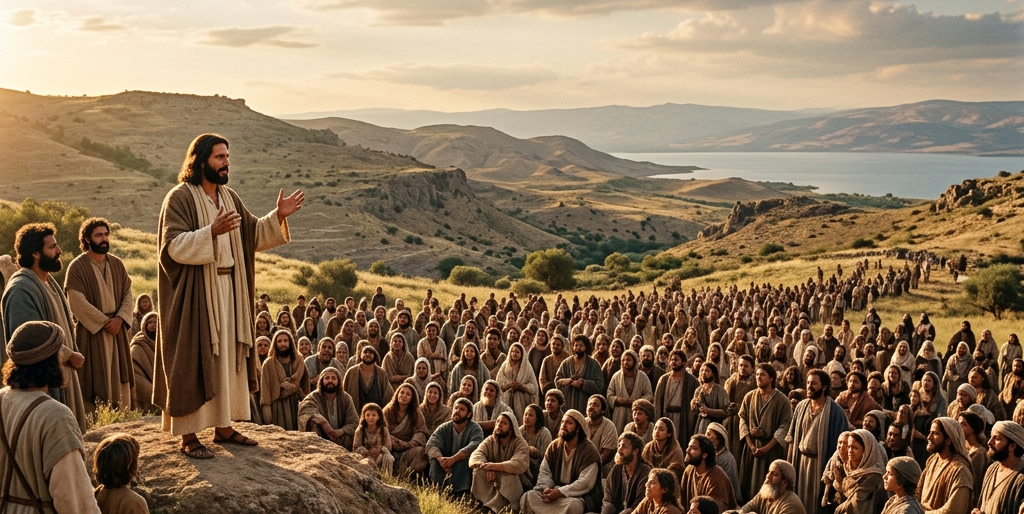
Blessings vs Woes
The Sabbath Controversies
One Sabbath, Jesus was going through the grainfields, and his disciples began to pick some heads of grain, rub them in their hands and eat the kernels. 2 Some of the Pharisees asked, “Why are you doing what is unlawful on the Sabbath?”
Mosaic regulations allow Israelites to “eat the kernels with [their] hands” (Deut 23:25)—without using an instrument for threshing—when they enter their neighbor’s field. To the Pharisees, to “rub [heads of grain] in their hands” was threshing; it was therefore “unlawful on the Sabbath.” The Pharisees viewed the “Sabbath Rest” as a passive avoidance of sin, whereas Jesus viewed it as an active pursuit of goodness. Taking the law out of context to suit their needs and referring to the Pharisaic tendency to obsess over the mechanics of the law (like tithing) while ignoring the morality of the law (Micah 6:8).
3 Jesus answered them, “Have you never read what David did when he and his companions were hungry? 4 He entered the house of God, and taking the consecrated bread, he ate what is lawful only for priests to eat. And he also gave some to his companions.” 5 Then Jesus said to them, “The Son of Man is Lord of the Sabbath.”
1. The Legal Conflict: Tradition vs. Permission
The Mosaic Law explicitly allowed Israelites to pluck grain by hand when passing through a neighbor’s field (Deut 23:25). However, the Pharisees had constructed a “fence” around the Law with extra-biblical traditions.
- The Accusation: To the Pharisees, the simple act of “rubbing grain” was technically categorized as threshing—a type of work forbidden on the Sabbath.
- Distortion: They obsessed over the mechanics of the law (technical tithing and ritual purity) while ignoring its morality. By turning a day of rest into a day of surveillance, they neglected what Jesus later identified as the “weightier matters” of justice, mercy, and faithfulness (Matthew 23:23).
2. The David Precedent and Divine Authority
Jesus counters this legalism by citing King David (1 Samuel 21) to prove that human need takes precedence over ceremonial ritual.
- The Logic of Mercy: David and his men ate the “Bread of the Presence,” which was reserved strictly for priests. Jesus argues that if David—the “man after God’s own heart”—could bypass a divine ceremonial command to preserve life, then the disciples were certainly justified in bypassing a man-made interpretation to satisfy hunger while serving the Messiah.
- “Lord of the Sabbath”: Jesus’ claim to be the “Lord of the Sabbath” is a massive claim to divinity. He essentially declares: “I am the one who instituted the Sabbath. I define its purpose, not your traditions.” He reframes the day from a restriction to a restoration, famously noting that the Sabbath was made for man, not man for the Sabbath.
Irony
The ultimate irony is that the Pharisees used the Law (which was meant to reveal God’s character) as a weapon to judge others. By quoting David, Jesus shows that true “unlawfulness” isn’t accidentally “threshing” a few seeds; it’s having a heart so hard that you value a ritual over a hungry person.
3. The Micah Connection: Tithing vs. Justice
The obsession with “rubbing grain” illustrates the mechanical nature of counting seeds reflects a broader Pharisaic pathology: the minutiae of the law while ignoring its moral heartbeat. While the Pharisees were meticulous about tithing 10% of even their smallest garden herbs, they missed the “Micah 6:8” requirement to act justly and love mercy.
The following table contrasts the rigid focus of the religious leaders with the heart-centered approach of Jesus:
| The Legalist Focus | The Jesus/Micah Focus |
| Threshing: Rubbing grain is defined as “work.” | Hunger: The Sabbath is intended for refreshment. |
| Tithing: Meticulously counting every leaf of mint. | Character: Seeking “to act justly and to love mercy.” |
| The Fence: Protecting the law via extra-biblical rules. | The Heart: Honoring the reason the law exists. |
4. Authority Demonstrated
Jesus does not just claim authority with words in the field; He proves it with power in the synagogue. While many today emphasize “keeping the Sabbath” solely as attending a service, Jesus prioritized time alone to restore His Spirit in prayer. Having established His authority over the Sabbath in the fields, He then enters the synagogue to demonstrate that authority through a definitive act of mercy, proving that it is always lawful to do good on the Sabbath.
Another Sabbath
6 On another Sabbath, he went into the synagogue and was teaching, and a man was there whose right hand was shriveled. 7 The Pharisees and the teachers of the law were looking for a reason to accuse Jesus, so they watched him closely to see if he would heal on the Sabbath. 8 But Jesus knew what they were thinking and said to the man with the shriveled hand, “Get up and stand in front of everyone.” So, he got up and stood there.
9 Then Jesus said to them, “I ask you, which is lawful on the Sabbath: to do good or to do evil, to save life or to destroy it?”
10 He looked around at them all, and then said to the man, “Stretch out your hand.” He did so, and his hand was completely restored. 11 But the Pharisees and the teachers of the law were furious and began to discuss with one another what they might do to Jesus.
The “Twist” of the Synagogue
The conflict escalates when Jesus encounters a man with a shriveled hand. The Pharisees watched closely, hoping for an excuse to accuse him. Jesus exposes their hypocrisy with a single question: “Which is lawful on the Sabbath: to do good or to do evil, to save life or to destroy it?” The shriveled hand metaphor alludes to those who have grown weary of rhetoric. In our own homes, churches synagogues our souls has become more of a doormat that is dying for the light. But Christ Jesu Came to restore us through his Grace love and mercy
The ultimate irony? The Pharisees were so protective of “Sabbath Rest” that they became restless with murderous anger, while the man with the shriveled hand found true rest through healing. They used the Law—meant to reveal God’s character—as a weapon to judge others.
The Twelve Chosen
12 One of those days Jesus went out to a mountainside to pray and spent the night praying to God. 13 When morning came, he called his disciples to him and chose twelve of them, whom he also designated apostles: 14 Simon (whom he named Peter), his brother Andrew, James, John, Philip, Bartholomew, 15 Matthew, Thomas, James son of Alphaeus, Simon who was called the Zealot, 16 Judas son of James, and Judas Iscariot, who became a traitor.
The direct result of that night of prayer, shows that while the Pharisees were plotting “what they might do to Jesus” (v. 11), Jesus was consulting the Father to build the future of the Church. While the religious leaders held a council of hate, Jesus held a council of prayer. His night on the mountain wasn’t a formal ritual, but a ‘natural, direct conversation’—the very intimacy the Pharisees were missing in their legalism.
Mirroring the Plain: The Symmetry of Blessings and Woes
In the Gospel of Luke, the setting of Jesus’ teaching provides a distinct theological contrast to the “Sermon on the Mount” found in Matthew. While Matthew depicts Jesus ascending a mountain—reminiscent of Moses receiving the Law—Luke 6:17 describes Jesus coming down to stand on a “level place” or a plain. This geographical shift sets the stage for a “mirroring effect,” where Jesus levels the social and spiritual playing field through a series of parallel Blessings and Woes.
1. The Context of the Twelve
Luke provides a specific chronological marker for this teaching. The “Sermon on the Plain” occurs immediately after a night of solitary prayer and the official appointment of the Twelve Apostles (Luke 6:12–16). By delivering this message right after forming His inner circle, Jesus establishes the “constitution” of His Kingdom—a kingdom where the values of the world are systematically inverted.
2. The Mirroring Effect: A Divine Equilibrium
On the plain, Jesus creates a symmetrical balance. For every “Blessing” (Beatitude) He offers to the marginalized, He reflects a corresponding “Woe” to the comfortable. This structure functions like a mirror, forcing the listener to see where they stand in the economy of God.
| The Blessing (The Uplifted) | The Woe (The Leveled) |
| The Poor: “Yours is the kingdom of God.” | The Rich: “You have already received your comfort.” |
| The Hungry: “You will be satisfied.” | The Well-Fed: “You will go hungry.” |
| The Weeping: “You will laugh.” | The Laughing: “You will mourn and weep.” |
| The Hated: “Great is your reward in heaven.” | The Popular: “Woe when everyone speaks well of you.” |
3. Leveling the Social Landscape
By choosing a plain rather than a peak, Luke emphasizes the accessibility and communal nature of Jesus’ ministry.
- Horizontal Theology: On the plain, Jesus is at eye level with the “large crowd of disciples” and the “great number of people from all over Judea” (Luke 6:17).
- The Great Reversal: The mirroring effect serves as a warning that the current status quo is temporary. Jesus “levels” the sides by promising that those currently in the “valleys” of suffering will be raised up, while those on the “peaks” of self-sufficiency will be brought low.
4. Summary of Intent
Through this symmetrical discourse, Jesus redefines success. The Pharisees sought righteousness through the “fence” of the law and social standing; Jesus defines it through our reaction to poverty, hunger, and persecution. He isn’t just delivering a sermon; He is describing a new reality where the mirror of the Gospel reflects the heart’s true condition.
Love My Enemies? The Impossible Command
“Love your enemies… do good to those who hate you.” (Luke 6:27)
When we read these words, our natural reaction is to recoil. We ask: “Does Jesus not know what I’ve been through? The hurt, the shame, the betrayal?” We justify our bitterness because the person who wronged us is neither good nor trustworthy. Blessings and Woes are the landscape, while Loving Enemies is the requirement for walking on that landscape.
However, the “why” behind this impossible command is found in the heart of the Lord’s Prayer:
“And forgive us our debts, as we also have forgiven our debtors.” (Matthew 6:12)
1. The Economy of Grace
Jesus isn’t asking us to be “nice”; He is asking us to mirror the Divine character. To receive the Grace we so desperately need, we are asked to extend that same Grace to others—even to our enemies. If we demand “repayment” or “justice” for every personal slight, we are still living under the Pharisaic Law of “tit-for-tat” rather than the Kingdom Law of Mercy.
2. Giving Without Strings
Jesus takes the “Sabbath heart” and applies it to our possessions and our pride:
- Generosity without Audit: If someone is in need, give without the “strings” of questioning or the expectation of repayment.
- The Ultimate Example: Christ gave His life for us while we were still “debtors”—still sinners, ungrateful, and wicked.
3. Why We Can’t Do It Alone
This kind of love is humanly impossible. We cannot “turn the other cheek” through sheer willpower when our hearts are breaking. We can only do it because He did it first. Through His rising, He affords us the Grace we need to be made whole—a wholeness we can never achieve on our own.
The “credit” doesn’t come from loving the lovable; it comes from being “children of the Most High,” who is kind even to the ungrateful.
The Pharisees thought they could be righteous on their own by following rules. Jesus shows that true righteousness (loving an enemy) is so high a bar that we have to rely on Him just to take the first step.
1. Shifting Weight
Shifting the weight to Christ is the essence of the Gospel. In the “Level Place” of Luke 6, Jesus isn’t just leveling social classes; He is leveling the “debt” of sin.
- The Exchange: When we forgive, we aren’t saying the hurt didn’t matter or that the sin was “okay.” We are saying, “I am handing this debt over to the only One who can truly pay it.”
- Breaking the Mirror: If we harbor hate, we become “just like those who oppress us.” Forgiveness is the only way to break that mirror. It prevents the victim from becoming a version of the victimizer.
2. Cutting the Chains
The “chains that bind us” are often forged from our own desire for “repayment.” By choosing Grace, you aren’t just letting the other person off the hook, you are letting yourself out of prison.
3. The Opportunity for the Other
This is the most “Christ-like” part of your reflection: the idea that our forgiveness creates a space for the other person to reflect.
- Mirroring Grace: When someone expects a “slap back” and receives a “turned cheek” or a prayer instead, it disrupts their reality. It acts as a mirror that shows them their own darkness, not through our judgment, but through the contrast of Christ’s light.
- The Invitation: As you said, they are then “afforded that same forgiveness.” Whether they take it or not is between them and God, but by forgiving, you have at least opened the door for them to see what Grace looks like in the flesh.
Summary of your Theological “Flow”
| The Action | The Spiritual Result | The Relational Result |
| Harboring Hate | We become like the oppressor; the soul shrivels. | The cycle of “evil for evil” continues. |
| Forgiving Self | We acknowledge our own need for the Grace we seek. | We stop the internal bleed of shame. |
| Forgiving Others | The weight is shifted to Christ; the chains are cut. | The other person is released to face the truth. |
Earthly Treasures or Heavenly Treasures
You know for a while I thought it would be nice to have 3 to 4 pair of boots, caps and so I started collecting Cowboy hats but that did not satisfy me it only made me look selfish, I was worried about the outside look needless to say I am growing old but for a while I became what I hated the most a person of thin skin But you know I can only wear only one pair of boots at a time and one hat at a time and if people can not see me for who I am why should I be worried its what’s in my heart that Counts I was storing up treasures that will never come with me and worst of all I made sure my initials where placed on the inside lol this leads to the question what is important to you the earthly look and treasures or your soul
The Anatomy of Judgment
1. The Usurped Throne
Judgment is not merely a social critique; it is a theological trespass. To judge is to attempt to sit in a seat that belongs solely to the Divine.
- The Jurisdiction of Christ: Judgment is not the designated work of the individual or the collective Church. When a pulpit or a community becomes a source of condemnation—targeting beliefs, lifestyles, or preferences—it ceases to be a place of healing and begins to mimic the Pharisaic synagogue.
- The Boomerang Effect: Jesus establishes a spiritual law of reciprocity: “Do not judge, and you will not be judged.” The measure one uses to evaluate others becomes the standard used by God to evaluate the soul. A “ruler” of rigid condemnation inevitably becomes the instrument that measures the one holding it.
2. Speck Surgery and Log Vision
Jesus uses a vivid, almost hyperbolic metaphor to expose the absurdity of daily gossip and moral scrutiny.
- The Speck (The Other): Human nature often possesses microscopic vision for the faults of others. We zoom in on “specks”—perceived flaws in lifestyle or belief—with the precision of a surgeon, ignoring the humanity of the person.
- The Log (The Self): While focused on the neighbor’s speck, the judge often carries a literal timber—the “log” of pride or self-righteousness—protruding from their own eye. This internal blindness is far more obstructive than the external flaw being criticized.
- The Definition of Hypocrisy: According to Jesus, the “hypocrite” is not defined by having a log, but by the pretense of spiritual clarity while attacking the speck in another. True “surgery” (helping a brother or sister) can only occur after the log of pride is removed.
3. The Currency of Forgiveness
In place of the “tit-for-tat” economy of judgment, Jesus introduces the economy of Mercy.
“Give, and it will be given to you. A good measure, pressed down, shaken together and running over, will be poured into your lap.”
While frequently applied to financial tithing, the immediate context of this promise is forgiveness. When an individual “pours out” non-judgment and mercy onto others, the Kingdom responds by pouring an overflowing measure of grace back into that person’s life.
4. Integration: The Shriveled Heart vs. The Level Place
The conflict between the Church and the world is often a conflict of “restoration” versus “reputation.”
- The Shriveled Heart: Much like the Pharisees who preferred a man remain crippled rather than see a Sabbath rule broken, a judgmental community prefers to stay “right” rather than see a soul restored. It values the mechanic of the law over the heartbeat of Micah 6:8.
- The Beggar’s Logic: On the “Level Place,” no one stands on higher ground. Every person is a “debtor” whose debt has been cleared by the same Master. In this reality, it is logically impossible for one beggar to condemn the way another beggar carries their bowl.
Summary of the Kingdom Shift
| The Pharisaic Foundation | The Kingdom Foundation (The Plain) |
| Action: Judging/Condemning from a height. | Action: Forgiving/Giving from the level ground. |
| Vision: Searching for “specks” in neighbors. | Vision: Removing the “log” of pride from self. |
| Identity: Secure self-righteousness. | Identity: Secure in being a “child of the Most High.” |
| Result: A shriveled, defensive spirit. | Result: A “running over” measure of grace. |
A Tree and Its Fruit: The Source of the Soul
This section answers the “Why?” Why were the Pharisees so angry? Why did earthly treasures did not satisfy me or you?
- The Interior Well: A tree doesn’t “try” to grow fruit; fruit is the natural overflow of its health.
- The Heart as the Storehouse: Jesus uses the word “treasure” again. “A good man brings good things out of the good stored up in his heart.” If the heart is a storehouse of legalism and “initial earthly treasures, then his heart and soul belong here on earth” that’s what will come out. If it’s a storehouse of Grace, mercy is what will grow.
The Two Builders: The Foundation of Practice
This is the grand finale of the Sermon on the Plain. It’s the difference between a “doormat soul” and a “restored soul.”
- Hearing vs. Doing: The “Wise Builder” isn’t the one who knows the most theology; it’s the one who acts on the words. This pulls back to your Micah 6:8 point: acting justly and loving mercy.
- The Flood: Life will “level” everyone. The storms (grief, betrayal, aging) hit both houses. The only difference is the foundation.
- The Bedrock: To build on the rock is to build on the “Lord of the Sabbath.” When the “shifting weight” of life hits, the person anchored in Christ’s mercy stands firm, while the house of legalism and earthly treasures “collapses with a great crash.”
The Economy of the Level Place
The discourse of Luke 6 serves as a divine “leveling” of human experience. Through the Sabbath Controversies, Jesus dismantles the vertical hierarchy of legalism, replacing it with a Horizontal Theology that prioritizes human need and mercy over ritualistic purity. By descending to a “level place” to deliver His blessings and woes, He establishes a Kingdom where social and spiritual status is inverted: the marginalized are uplifted, and the self-sufficient are warned.
The text moves from external conduct to internal character, culminating in the metaphor of the Two Builders. The transition from “hearing” to “doing” marks the difference between a life built on the shifting sands of earthly treasure and a life anchored in the bedrock of Christ’s mercy. Ultimately, the “Mirroring of the Plain” calls the believer to reflect the character of the Father—extending the same measure of grace to others that they have received from the Lord of the Sabbath.
Closing Prayer
Heavenly Father, Lord of the Sabbath and Architect of the Heart,
We thank You for the “level place” where Your grace meets our brokenness. Forgive us for the times we have branded our own names on earthly treasures and ignore the weightier matters of justice and mercy. Grant us the “healthy eye” to see others through the lens of Your love, rather than through the logs of our own pride. Help us to shift the weight of our burdens and our judgments onto the shoulders of Christ, that we may stand firm when the storms of life arise. May our lives be the fruit of Your Spirit, rooted in the bedrock of Your truth. Amen.
Tomas The-Way.blog
© 2026 The-Way.blog Digital Publications. All Rights Reserved.
Scholarly Footnotes & Biblical References
1. The Sabbath and the “Fence”
Deuteronomy 23:25: The Mosaic permission for plucking grain by hand.
Mishnah Shabbat 7:2: Defines the “39 Melakhot” (categories of work), where “reaping” and “threshing” are forbidden. The Pharisaic “fence” around the law categorized the rubbing of grain as a violation of these categories.
1 Samuel 21:1–6: The precedent of David and the Bread of the Presence used by Jesus to prioritize the “Law of Mercy” over ceremonial law.
2. The Symmetry of the Plain
Luke 6:17–26: The parallel structure of four blessings and four woes, often contrasted with the nine beatitudes in Matthew 5.
Isaiah 61:1: The prophetic background for Jesus’ proclamation of “good news to the poor.”
3. Ethics of the Kingdom
Micah 6:8: The tripartite requirement of the prophet—to act justly, love mercy, and walk humbly—serves as the moral heartbeat of Jesus’ critique of tithing (cf. Matthew 23:23).
Leviticus 19:18: The original command to “love your neighbor,” which Jesus expands in Luke 6 to include the “impossible command” of loving one’s enemies.
4. The Anatomy of Judgment
Matthew 7:1–5 / Luke 6:37–42: The “Log and Speck” discourse. The Greek term hypokritēs originally referred to a stage actor, highlighting the “pretense” of those who judge others while hiding their own faults.
Exodus 20:10: The Sabbath command, reframed by Jesus not as a day of “surveillance,” but as a day of “restoration.”
5. Final Foundation
Isaiah 28:16: The prophetic promise of a “tested stone, a precious cornerstone for a sure foundation.”
James 1:22–25: The New Testament echo of the “Wise Builder,” emphasizing the necessity of being “doers of the word, and not hearers only.”
 The-Way
Leave a comment