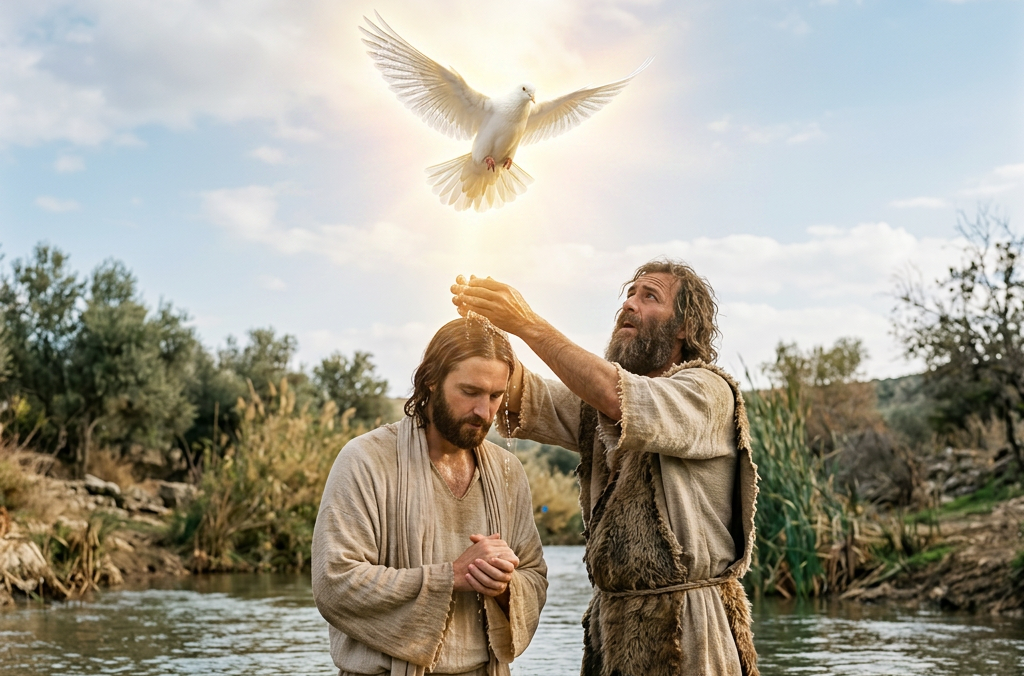
John the Baptist
Introduction
Luke’s Gospel is shaped by a unique dual perspective: the meticulous mind of a historian and the compassionate heart of a healer. His writing seamlessly blends scholarly precision with deep empathy. While Matthew, Mark, and Luke all record the ministry of John the Baptist, their distinct priorities reveal different facets of his mission:
- Matthew emphasizes the prophetic aesthetic, focusing on John’s rugged clothing, his diet, and his fiery confrontation with the religious elite.
- Mark opts for immediacy, opening his Gospel with John’s arrival and offering a brief, punchy description of his appearance.
- Luke, ever the historian, begins by anchoring John’s entrance within a specific chronological timeframe. While he does not shy away from John’s rebuke of the leaders, he uniquely shifts the focus toward the crowd’s response. By addressing their direct questions (“What then should we do?”), Luke highlights a practical path to redemption and the active “paving of the way” for everyday people.
The Prophetic Call
As it is written in the book of the words of Isaiah the prophet:
“A voice of one calling in the wilderness, ‘Prepare the way for the Lord, make straight paths for him. Every valley shall be filled in, every mountain and hill made low. The crooked roads shall become straight, the rough ways smooth. And all people will see God’s salvation.’” — Luke 3:4-6 (NIV)
Commentary and Context
Luke portrays John’s ministry primarily as a call to repentance. This ministry of baptism was unprecedented; while Judaism practiced repeated washings for temporary ritual cleansing, John called for a one-time baptism to mark the arrival of the era of salvation.
The concept of repentance is rooted in the Old Testament tradition of turning away from sin and toward God. To be prepared for God’s salvation, one’s heart must be open to His message. However, the availability of salvation also implies a coming judgment; the opportunity for grace becomes a tragedy if the hearer does not respond. Ultimately, Luke reminds us that salvation is not a matter of family inheritance, but of individual faith and turning in trust to the living God.
The Fruits of Repentance
Luke 3:7–14 elaborates on the practical nature of this repentance. John’s sharp rebuke in verse 7 is directed at those who believe that the act of baptism is a “get out of judgment free” card. He clarifies that ritual without transformation is hollow:
- The Warning: John warns that physical descent from Abraham does not guarantee a place in God’s family. God determines membership based on spiritual life, not genealogy.
- The Urgency: The imagery of the “ax at the root” signifies that judgment is imminent.
- The Application: When the crowds, tax collectors, and soldiers ask, “What should we do?”, John’s answers are remarkably practical. He defines repentance through radical generosity, honesty in business, and contentment in one’s station.
The Coming One
As the people wondered if John might be the Messiah, he redirected their focus toward the One to come:
“I baptize you with water. But one who is more powerful than I will come, the straps of whose sandals I am not worthy to untie. He will baptize you with the Holy Spirit and fire.” — Luke 3:16
John concludes with the imagery of the winnowing fork, emphasizing that the coming Messiah will distinguish between the “wheat” (those who respond in faith) and the “chaff” (those who reject the call). Through these exhortations, John successfully “paved the way” by proclaiming the good news of a coming Savior who demands a transformed heart.
The Baptism of Jesus
“When all the people were being baptized, Jesus was baptized too. And as he was praying, heaven was opened and the Holy Spirit descended on him in bodily form like a dove. And a voice came from heaven: ‘You are my Son, whom I love; with you I am well pleased.’” — Luke 3:21-22
Few moments are as significant as when heaven speaks. Jesus’ baptism highlights three crucial points:
- Validation: By submitting to this washing, Jesus declares John’s message to be true and confirms that humanity must prepare for salvation.
- Prayer: Luke specifically notes that Jesus was praying when the Spirit descended, reflecting a consistent theme in this Gospel: Jesus bathes His life and ministry in prayer.
- Anointing: This event serves as a divine “anointing.” The Spirit—associated with God’s creative work and the presence of His grace—descends like a dove, while the Father vocally identifies Jesus as His Son.
Old Testament Allusions
God’s declaration weaves together three prophetic threads:
- Psalm 2:7: Identification as the Messianic Son.
- Isaiah 42:1: The identity of the Chosen Servant.
- Isaiah 41:8: The alignment of a chosen servant with a beloved person (a widely supported allusion where the ideas of “chosen” and “beloved” converge).
Genealogy: A Global Connection
Luke traces Jesus’ lineage in reverse, moving from the present back to the very beginning:
“…the son of Enosh, the son of Seth, the son of Adam, the son of God.” — Luke 3:38
This list introduces a vast variety of humanity, from the famous to the forgotten. By ending with Adam, Luke demonstrates that Jesus is the Savior for all people, connected to every person through our shared origin. This provides a detailed, personal touch: if Adam is the “son of God,” then by extension, all humanity is connected to God. However, like Adam, we are presented with a choice.
The question remains: Are you in or out? Are you with God or not? Do you have faith?
Closing Prayer
Heavenly Father, thank You for the voice crying in the wilderness, calling us to make our paths straight. We thank You for the example of Jesus, who bathed His life in prayer and obedience. Open our hearts to true repentance—not just in ritual, but in radical generosity and honesty. May we choose this day to walk in faith, recognizing our connection to You and accepting the salvation offered through Your Son Jesus Christ. Amen.
Tomas
The-Way.blog
© 2026 The-Way.blog Digital Publications. All Rights Reserved.
References & Resources
Biblical References:
- Isaiah 40:3–5: The prophecy of the voice in the wilderness.
- Malachi 3:1: The messenger preparing the way.
- Psalm 2:7: The decree of the Sonship.
- Isaiah 42:1: The Spirit-anointed Servant.
- Genesis 5: The origin of the human lineage traced in the genealogy.
Citations: [1] Holy Bible, New International Version®, NIV® Copyright ©1973, 1978, 1984, 2011 by Biblica, Inc.® [2] NIV Application Bible Original Meaning Notes, Application Notes, copyright © 2025. [3] NIV Grace and Truth Study Bible, General Editor R. Albert Mohler Jr., Zondervan, 2021.
Resources for Further Study:
The Bible Project: Introduction to the Gospel of Luke.
The Gospel of Luke, New International Commentary on the New Testament (NICNT).
Luke: Baker Exegetical Commentary on the New Testament, Darrell L. Bock.
 The-Way
Leave a comment